


ACTIVE STUDIES
- Exploring Policing Career Sustaining Factors Among Former Victorian Policewomen
- Exploring Everyday Experiences and Boundary-Setting in Conversational Generative Artificial Intelligence Use Among Australian Young Adults
- Working with clients who have experienced developmental trauma: A qualitative analysis of psychologists’ experience of bottom-up approaches
- The Role of Self-Connection and Sense of Self in Loneliness
- Institutional Language and LGBTQ+ Identity Development: A Thematic Narrative Analysis of Retrospective Accounts of Adolescence
- Predicting Workplace Success and Perceived Workplace Performance by Assessing Narcissism, Machiavellianism and Psychopathy
- Have you ever thought, “What Just Happened?”
- Understanding the Links Between Perfectionism, Self-Compassion, and Mental Health
- Making Sense of “Good Support”: Positive Behaviour Support Practitioners’ Experiences of Professional Uncertainty in Real-World Practice
- Making Sense of Multiracial Identity in Australia: An Interpretive Phenomenological Study of Australian-Born, Mixed-Race Young Adults
- Internal Pressures and Professional Identity in Early-Career Teachers: A Self-Determination Theory Perspective
- An Integrated Model: The Cognitive-Emotional Mechanisms of The Dark Tetrad-Aggression Link
- Navigating Acculturative Stress Through AI: A Qualitative Study of Chinese International Students’ Coping and Adjustment
- Problematic Smartphone Use and Mental Health: The Role of Psychological Vulnerability Factors
- The Effect of Personality on the Relationship Between Leisure and Wellbeing
- Predicting Workplace Success and Perceived Workplace Performance by Assessing Narcissism, Machiavellianism and Psychopathy
- Migrant Wellbeing in Australia
- Psychologists’ Perspectives on the Therapeutic Barriers to Adolescents Accessing Therapy. A Qualitative Study
- Organisational Justice, Workplace Bullying, and Personality
- Emotional Intelligence and Wellbeing in Australian Informal Carers: The Roles of Benefit Finding and Age
- The Clinical Utility of the HiTOP: An Investigation
- Attitudes Towards Cosmetic Surgeries: The Role of Self-Concept Clarity, Empathy, Body Image, and Media Exposure in an Australian Sample
- Functional Impairment among Australian Adults: The Role of Crisis-Media Exposure and Distress Tolerance
- The Association of Previous Gaslighting Exposure to Narrative Identity: The Roles of Epistemic Trust and Self-Concept Clarity
- Instagram, Embodied Wellbeing, and Digital Pruning: Pathways to Orthorexia Nervosa in Women and Woman-identified Persons in Australia
- Social Environments and the Gender Diverse Self: A Thematic Enquiry
- Women Academics’ Experiences of Manosphere-related Gender-Based Behaviours in Australian Higher Education: A Thematic Discourse Analysis
- The Lived Experience of South Asian Parents Migrating to Australia to Join Adult Children: A Phenomenological Inquiry
- Behavioural Clustering and its Association with Psychological Distress in University Lecturers: A Cross-Sectional Analysis
- The Role of Moral Disengagement in the Link Between Masculinity Beliefs and Online Aggressive Behaviour
- Living with Psoriatic Arthritis: A Qualitative Exploration of Female Identity in Established Adulthood
- Perceptions of Mental Health and Help-Seeking Behaviours Among Young People in Rural Australia: A Qualitative Community Study in Far West NSW
- The Moderating Role of Cultural Orientation on the Relationship Between Coping Strategies, Social Support, and Resilience in International Students
- Offender Cultural Background and Public Responses to Juvenile Crime in Australia
- Attitudes toward Mental Health and Help-Seeking Intention
- Relationships Among Identity Importance and Salience, Informal Mental Health Support, and Distress in LGBTQIA+ Communities
- AI Attachment Strength as a Moderator of Relational AI Use and Mental Health Outcomes
- The Cost of Convenience: Conditional Pathways Linking Generative Artificial Intelligence Use to Critical Thinking via Cognitive Offloading
- Academic Self-Confidence
- An Investigation of Functional Social Support Types on Parental Stress and Self-Efficacy and the Moderating Influence of Number and Age of Children
- Living with Dissociative Identity Disorder in Australia: A Phenomenological Study of Mental Health Care Experiences
- The Impact of Connections and Values on Mental Health
To view past and completed research studies from ACAP, please click here.
Exploring Policing Career Sustaining Factors Among Former Victorian Policewomen
ELIGIBILITY CRITERIA
You may be eligible to participate if you:
- Identify as a woman and are a sworn previously served as a sworn member of Victoria police member
- Have Completed at least 5 years of operational service
- Left Victoria Police within the past 10 years
- Do not have a personal relationship with the researcher
- Currently reside in Australia
STUDY DESCRIPTION
Women remain underrepresented in policing, and research has largely focused on barriers, discrimination, and attrition. Less is known about how women understand the factors that sustained their careers and maintained ambition within male-dominated policing organisations. This study explores how former sworn women police officers make sense of their career journeys and ambitions over time, with a focus on how personal strengths, psychological resources and workplace conditions interacted to support women to remainshape the sustainability in of their policing careers over time.
Using a qualitative design, 10 to 15 former sworn women police officers will participate in semi-structured interviews. Interviews will be audio-recorded, transcribed, and analysed using reflexive thematic analysis to identify patterns across participants’ narratives of career development, and career sustaining factors acrossand eventual departure from policing.
The study integrates organisational and psychological perspectives to contribute to academic understanding of career sustainability in policing and how individual and structural factors shape long-term career engagement in male-dominated occupations.
NAMES OF INVESTIGATORS
Dr Charini Gunaratne, Hannah Ghate
HREC APPROVAL NUMBER
This research has been approved by the ACAP University College HREC (EC00447) (Approval Number: 995190626). For concerns about ethical aspects of this research, please contact the ACAP HREC: [email protected].
SURVEY LINK
https://acap.au1.qualtrics.com/jfe/form/SV_er4HyrI61JtJHsq
RESEARCH PARTICIPANT INFORMATION STATEMENT
https://1drv.ms/b/c/395c06594a774e2c/IQA_OFhPyqApSrP_Mf9eHXcYAeNTd4bUK4uGTFmfD4EBcpU?e=oPcbDI
PROJECT END DATE
31 December 2026
BACK TO TOP
Exploring Everyday Experiences and Boundary-Setting in Conversational Generative Artificial Intelligence Use Among Australian Young Adults
ELIGIBILITY CRITERIA
- are aged 18 to 29 years
- live in Australia
- have used a conversational GenAI tool, such as ChatGPT or a similar tool, at least once daily in the last six months
- have sufficient English to take part in an interview and provide informed consent
- do not have personal relationship with the researcher
STUDY DESCRIPTION
This study explores how young adults experience and make sense of their everyday interactions with conversational artificial intelligence (AI) tools, such as ChatGPT. The study is interested in how young adults use and interpret conversational AI in their daily lives, including what roles these tools play and what they find helpful, meaningful, or concerning about their interactions. It also explores how young adults understand and enact boundaries when using conversational AI, including decisions about sharing personal information, relying on AI for advice or support, and managing feelings of connection or closeness with these systems.
Through interviews with young adults aged 18–29, the study aims to develop a better understanding of how conversational AI fits into everyday life and how users navigate boundaries within these interactions.
NAMES OF INVESTIGATORS
Zainab Abizher Babrawala & Dr. Susan Abel
HREC APPROVAL NUMBER
This research has been approved by the ACAP University College HREC (EC00447) (Approval Number: 980310526). For concerns about ethical aspects of this research, please contact the ACAP HREC: [email protected].
PROJECT END DATE
31 December 2026
BACK TO TOP
Working with clients who have experienced developmental trauma: A qualitative analysis of psychologists’ experience of bottom-up approaches
ELIGIBILITY CRITERIA
Psychologists who are generally registered with the Australian Health Practitioner Regulation Agency (AHPRA); reside and work in Australia; and work with children, adolescents, or adults who have experienced developmental trauma.
STUDY DESCRIPTION
This study will be exploring Australian psychologists’ conceptualisation and use of bottom-up approaches, interventions, or strategies in working with clients who are adversely impacted by developmental trauma. This research aims to improve understanding of psychologists’ clinical perspectives of these approaches. It is a Master of Psychology Clinical (5th year) research project.
NAMES OF INVESTIGATORS
Gabrielle Duffy, Rebecca Mathews, Donna Radley
HREC APPROVAL NUMBER
This research has been approved by the ACAP University College HREC (EC00447) (Approval Number: 1007300726). For concerns about ethical aspects of this research, please contact the ACAP HREC: [email protected].
SURVEY LINK
https://acap.au1.qualtrics.com/jfe/form/SV_5ax1Kb8Se220CDY
PROJECT END DATE
31 December 2026
BACK TO TOP
The Role of Self-Connection and Sense of Self in Loneliness
ELIGIBILITY CRITERIA
To participate in this survey, we ask that you:
- Are an adult aged 18 and over
- Reside in Australia
- Read English proficiently enough by self-assessment to read and answer the survey questions.
STUDY DESCRIPTION
Most people will feel lonely sometimes. However, chronic loneliness can lead to physical and mental health issues. We are conducting research into the relationship between self-connection, sense of self, loneliness, and social connection. Participation involves completing a short confidential online questionnaire. The survey is estimated to take around 20 minutes to complete. Participation is entirely voluntary.
This research is being conducted by Tara Darlington ([email protected]), Dr Aileen Luo, and Ms Liz Sheppard.
Researchers’ relationship: Employees (Luo and Sheppard); Student (Darlington)
Your participation in this research can help improve understanding of and support for people experiencing loneliness in the Australian community.
NAMES OF INVESTIGATORS
Tara Darlington, Aileen Luo, Liz Sheppard
HREC APPROVAL NUMBER
This research has been approved by the ACAP University College HREC (EC00447) (Approval Number: 1000250626). For concerns about ethical aspects of this research, please contact the ACAP HREC: [email protected].
SURVEY LINK
https://acap.au1.qualtrics.com/jfe/form/SV_1FIJ9tYikwodPrU
PROJECT END DATE
31 December 2026
BACK TO TOP
Institutional Language and LGBTQ+ Identity Development: A Thematic Narrative Analysis of Retrospective Accounts of Adolescence
ELIGIBILITY CRITERIA
To participate in this survey, we ask that you:
- Are not in a personal relationship with any of the researchers
- Are 18 years of age or older
- Self-identify as part of the LGBTQ+ community
- Currently reside in Australia
- Can read, speak, and understand English sufficiently to participate in the interview
- Spent part of your adolescence in institutional environments in Australia (such as schools, sporting clubs, community organisations, faith-based settings, healthcare settings or similar contexts.
STUDY DESCRIPTION
This study explores how LGBTQ+ adults reflect on their experiences in institutional environments during adolescence, such as schools, sporting clubs, and community organisations. The study focuses on how the language used in these environments is understood over time and how these experiences may shape identity and resilience in adulthood.
NAMES OF INVESTIGATORS
Doctor Christopher Holt & Zoe Martini
HREC APPROVAL NUMBER
This research has been approved by the ACAP University College HREC (EC00447) (Approval Number: 1009070826). For concerns about ethical aspects of this research, please contact the ACAP HREC: [email protected].
ADDITIONAL INFORMATION
Participation involves taking part in a confidential one-on-one online interview via Zoom (up to 60 minutes). If you would like more information or are interested in participating, please contact:
Zoe Martini – [email protected]
PROJECT END DATE
31 December 2026
Download here
BACK TO TOP
Predicting Workplace Success and Perceived Workplace Performance by Assessing Narcissism, Machiavellianism and Psychopathy
ELIGIBILITY CRITERIA
You are eligible to take part if you:
- Are 18 years of age or older
- Are currently employed for at least 20 hours per week in a role that involves working with others
- Can read and understand English well enough by self-assessment to complete a survey in English.
To minimise potential conflicts of interest, you should not participate if you have a personal relationship with, or are known to, the researchers.
STUDY DESCRIPTION
This research project that explores how personality traits influence workplace behaviours and leadership outcomes. Specifically, we are interested in three traits known as the dark triad: narcissism (a sense of self-importance with desire for attention), Machiavellianism (a pattern of using others to meet one’s own needs), and psychopathy (not caring much about others’ feelings). These behaviours are manifested by all people to some degree and have been found to be related to both positive (leadership style and career success) and negative (interpersonal conflict, aggression, and workplace bullying) behaviours in the workplace. This study will examine whether impression management, or the tendency to present oneself favourably, influences relationships between the dark triad and positive and negative workplace behaviours.
NAMES OF INVESTIGATORS
Anthony de Wet, Sophie Blackmore, Prof Katarina Fritzon
HREC APPROVAL NUMBER
This research has been approved by the ACAP University College HREC (EC00447) (Approval Number: 977110526). For concerns about ethical aspects of this research, please contact the ACAP HREC: [email protected].
SURVEY LINK
https://acap.au1.qualtrics.com/jfe/form/SV_2rg692YtSsiUAlw?id=41866
PROJECT END DATE
November 2026
BACK TO TOP
Have you ever thought, “What Just Happened?”
ELIGIBILITY CRITERIA
To participate in this survey, we ask that you:
- Are 18 years or older
- Self-identify as Asian, Asian Australian, or as having Asian ancestry;
- Currently living in Australia.
STUDY DESCRIPTION
The study examines how people respond emotionally and behaviourally to different types of everyday interactions. Participants will complete an online survey and read one short scenario. Participants will then report their interpretation, emotional response, and intended behavioural response to the interaction.
NAMES OF INVESTIGATORS
Ruiwei Sun, Micheal Weston
HREC APPROVAL NUMBER
This research has been approved by the ACAP University College HREC (EC00447) (Approval Number: 1011130826). For concerns about ethical aspects of this research, please contact the ACAP HREC: [email protected].
SURVEY LINK
https://acap.au1.qualtrics.com/jfe/form/SV_bayJxKeOmkKxxKC
PROJECT END DATE
31 May 2027
BACK TO TOP
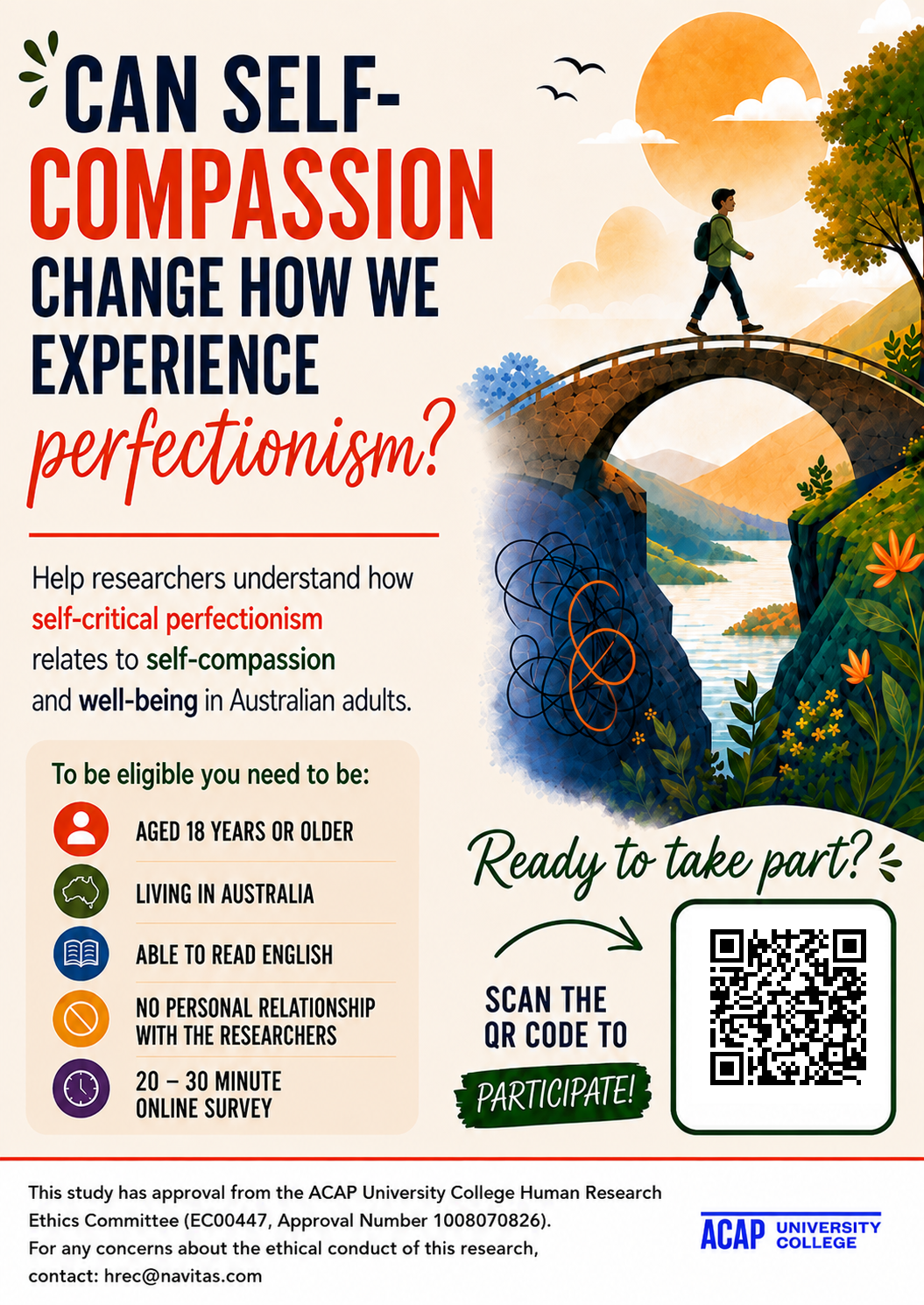
Understanding the Links Between Perfectionism, Self-Compassion, and Mental Health
ELIGIBILITY CRITERIA
You can take part if you:
- Are 18 years or older
- Live in Australia
- Can read and understand English well enough, by self-assessment, to complete the survey
- Do not personally know either researcher.
STUDY DESCRIPTION
Are You Your Own Harshest Critic?
We’re looking for Australian adults to take part in a study on perfectionism, self-compassion, and wellbeing.
Self-compassion involves responding to personal difficulties, mistakes and feelings of inadequacy with kindness, understanding and a balanced perspective rather than harsh self-criticism.
What’s involved: an anonymous online survey (about 20–30 minutes) with some questionnaires and a few demographic questions.
Understanding whether self-compassion changes how self-critical perfectionism is associated with flourishing and psychological distress may help clarify how people can experience
positive mental health despite being highly self-critical.
The findings may also inform future wellbeing and psychological support approaches.
NAMES OF INVESTIGATORS
Dr Daniel du Plooy and Neelam Hussein
HREC APPROVAL NUMBER
This research has been approved by the ACAP University College HREC (EC00447) (Approval Number: 1008070826). For concerns about ethical aspects of this research, please contact the ACAP HREC: [email protected].
SURVEY LINK
https://acap.au1.qualtrics.com/jfe/form/SV_3D8QzMI2q3EGogm
PROJECT END DATE
May 2027
Download here
BACK TO TOP
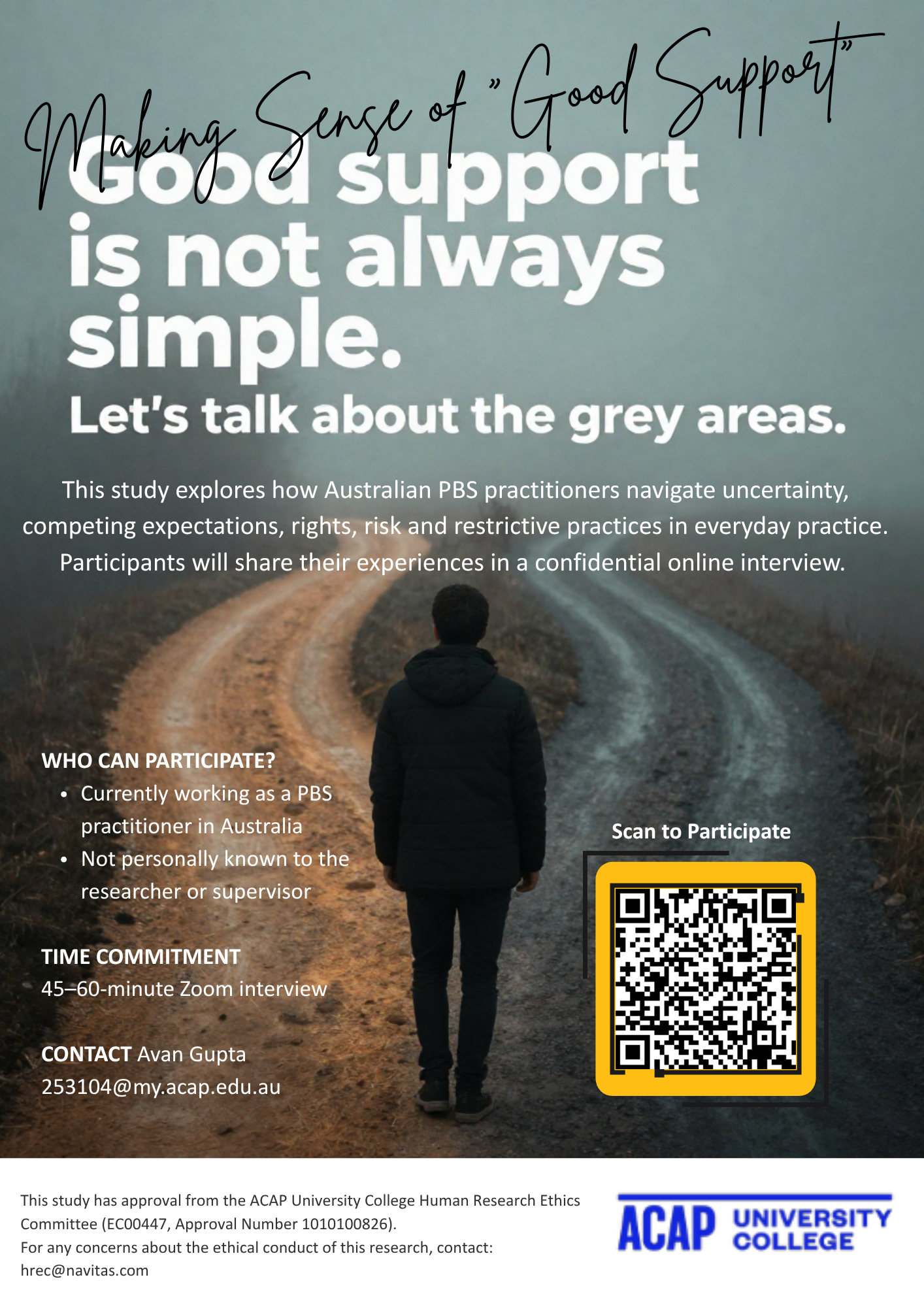
Making Sense of “Good Support”: Positive Behaviour Support Practitioners’ Experiences of Professional Uncertainty in Real-World Practice
ELIGIBILITY CRITERIA
To participate in this survey, we ask that you:
- Are currently practising as a Positive Behaviour Support practitioner in Australia
- Have no existing workplace, supervisory, or close relationship with either member of the research team.
STUDY DESCRIPTION
Australian Positive Behaviour Support (PBS) practitioners support people with disability through individualised behaviour support aimed at improving quality of life and reducing restrictive practices (that restrict a person’s rights or freedom of movement). Practitioners often make decisions without clear answers, balancing participant rights and safety with family expectations, staff capability, and service constraints. These judgments shape whether people experience autonomy and rights-based support, or unnecessary restriction and unmet needs. Known barriers to PBS practice include implementation challenges, staff training, and service constraints. Less is known about how practitioners navigate professional uncertainty when providing good support. This study aims to explore how PBS practitioners in Australia experience and make sense of professional uncertainty, and what supports confidence, reflection, and professional judgement. Semi-structured interviews with 8–10 practitioners will be analysed using Template Analysis. Findings may inform supervision and training, supporting more reflective, rights-based PBS practice.
NAMES OF INVESTIGATORS
Avan Gupta and Susan Abel
HREC APPROVAL NUMBER
This research has been approved by the ACAP University College HREC (EC00447) (Approval Number: 1010100826). For concerns about ethical aspects of this research, please contact the ACAP HREC: [email protected].
SURVEY LINK
https://acap.au1.qualtrics.com/jfe/form/SV_4JgzvRUe5239Clg
PROJECT END DATE
30 May 2027
Download here
BACK TO TOP
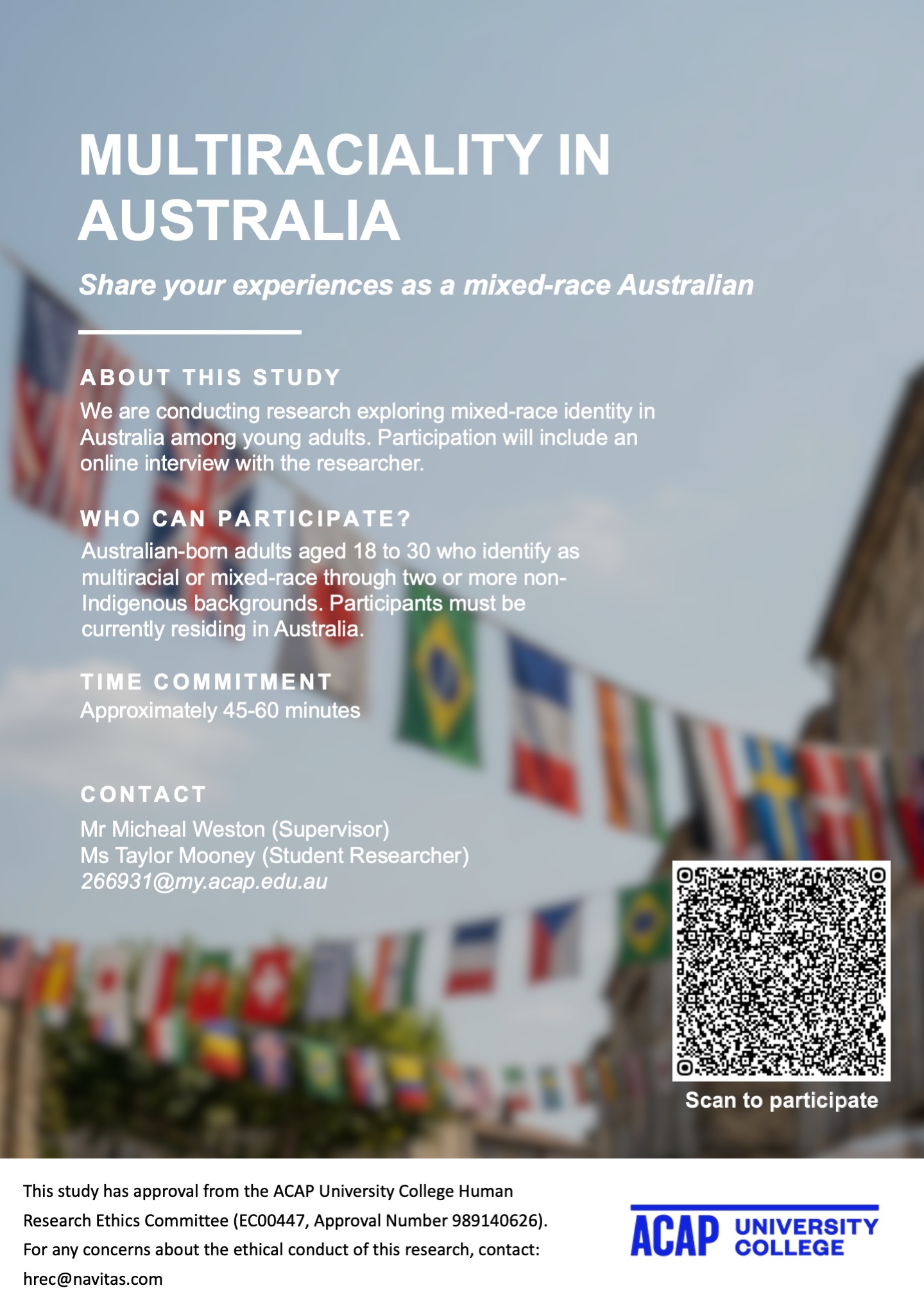
Making Sense of Multiracial Identity in Australia: An Interpretive Phenomenological Study of Australian-Born, Mixed-Race Young Adults
ELIGIBILITY CRITERIA
To participate in this survey, we ask that you:
- Are 18–30 years of age
- Self-identify as multiracial or mixed-race through two or more non-Indigenous racialised or ethnocultural backgrounds
- Were born in Australia and currently live in Australia
- Speak English well enough by own assessment to complete an interview and read a transcript in English
- Have no personal relationship with the researchers.
STUDY DESCRIPTION
You are invited to take place in a study that explores the development of mixed-race identity in Australia. The project looks at aspects of mixed-race identity (also commonly referred to as biracial or multiracial, meaning a person with multiple racial backgrounds) and Australian national identity to better understand the unique experiences of mixed-race people living in Australia. This includes how multiracial identity is formed in and understood by young multiracial Australian adults, and the ways that they experience this identity in day-to-day life.
If you decide that you would like to take part in this study, you will participate in an online interview (Zoom) comprising of 11 interview questions about your experiences as a mixed-race Australian person. The interview should take 45 to 60 minutes to complete.
NAMES OF INVESTIGATORS
Micheal Weston, Taylor Mooney
HREC APPROVAL NUMBER
This research has been approved by the ACAP University College HREC (EC00447) (Approval Number: 989140626). For concerns about ethical aspects of this research, please contact the ACAP HREC: [email protected].
PROJECT END DATE
November 2026
ADDITIONAL INFORMATION
Please contact the researcher by email at [email protected] to arrange a time to participate.
Download here
BACK TO TOP
Internal Pressures and Professional Identity in Early-Career Teachers: A Self-Determination Theory Perspective
ELIGIBILITY CRITERIA
To participate in this survey, we ask that you:
- Currently work in a Public School
- Teach any grades from 1-12
- Have been teaching for less than 5 years.
STUDY DESCRIPTION
Are you within your first 5 years of teaching grades 1-12 in a Queensland public school?
We’re conducting a research study exploring how early-career teachers experience pressures at work, how these pressures become personally meaningful, and how they shape teachers’ sense of themselves as professionals. The study aims to better understand how workplace experiences influence teachers’ personal standards and their sense of well-being.
Participation will involve one 45-60 minute online (Zoom) interview, with the option to review your transcript, and is completely confidential! Your insights will contribute to research aimed at better supporting early-career teachers’ wellbeing, professional growth, and retention in Australia.
NAMES OF INVESTIGATORS
Dr Andrew Napier; Luke Cappello
HREC APPROVAL NUMBER
This research has been approved by the ACAP University College HREC (EC00447) (Approval Number: 994190626). For concerns about ethical aspects of this research, please contact the ACAP HREC: [email protected].
SURVEY LINK
https://acap.au1.qualtrics.com/jfe/form/SV_0cavEDYA033esAe
PROJECT END DATE
18 December 2026

Download here
BACK TO TOP
An Integrated Model: The Cognitive-Emotional Mechanisms of The Dark Tetrad-Aggression Link
ELIGIBILITY CRITERIA
To participate in this survey, we ask that you:
- Are 18 years of age and over
- Understand English well enough to complete surveys and behavioural tasks based on own assessment
- Reside in Australia and not have a personal relationship with the researchers.
STUDY DESCRIPTION
Aggression poses devastating consequences, such as homicide. Therefore it is important to investigate the predictors of aggression. The dark tetrad (psychopathy, narcissism, Machiavellianism and sadism) appears to be one consistent predictor of aggression. The general aggression model (GAM theory) posits that personal factors and cognitive-affective-arousal states produce aggression, linking the dark tetrad with cognitive-emotional factors (emotion dysregulation, anger rumination, impulsivity and hostile attribution bias). By adopting a quantitative, cross-sectional research design, the current study aims to test whether cognitive-emotional mechanisms mediate the dark tetrad-aggression relationship using a multiple parallel mediation model (N= 156). The findings of this study will contribute to the literature by; 1) extending the person-aggression link proposed in GAM theory by proposing specific cognitive and affective factors that influence aggression through an integrated model and 2) informing therapeutic intervention and treatment to decrease aggression in individuals with higher dark tetrad traits through the management of cognitive-emotional mechanisms.
NAMES OF INVESTIGATORS
Dr. Haruka Kitamura (chief investigator) and Jazmin Sebo (student researcher)
HREC APPROVAL NUMBER
This research has been approved by the ACAP University College HREC (EC00447) (Approval Number: 1004060726). For concerns about ethical aspects of this research, please contact the ACAP HREC: [email protected].
SURVEY LINK
https://us.psytoolkit.org/c/3.7.0/survey?s=KAGgD
PROJECT END DATE
November 2026
BACK TO TOP
Navigating Acculturative Stress Through AI: A Qualitative Study of Chinese International Students’ Coping and Adjustment
ELIGIBILITY CRITERIA
To participate in this survey, we ask that you:
- Self-identify as a Chinese international student
- Were born in mainland China
- Are currently enrolled at an Australian university
- Are aged 18 years or older
- Have used AI-based conversational tools (e.g., ChatGPT) within the past six months.
STUDY DESCRIPTION
You are invited to take part in a study about how Chinese international students use artificial intelligence tools such as ChatGPT when dealing with challenges while studying in Australia. Many international students experience difficulties adjusting to a new country, including language barriers, academic pressure, and cultural differences. These experiences are often referred to as acculturative stress. We are interested in hearing about Chinese international students’ experiences of studying and living in Australia, how they use AI tools in everyday situations, and whether AI helps them manage challenges related to study or daily life.
NAMES OF INVESTIGATORS
Dr. Susan Abel
HREC APPROVAL NUMBER
This research has been approved by the ACAP University College HREC (EC00447) (Approval Number: 978110526). For concerns about ethical aspects of this research, please contact the ACAP HREC: [email protected].
SURVEY LINK
https://acap.au1.qualtrics.com/jfe/form/SV_3QpmwDYdJsRbVLo
PROJECT END DATE
30 November 2026
BACK TO TOP
The Effect of Personality on the Relationship Between Leisure and Wellbeing
ELIGIBILITY CRITERIA
To participate in this survey, we ask that you:
- Are 18 years of age or older
- Understand English well enough by own assessment to complete a survey in English
- Are currently residing in Australia
- Have no personal relationship with either of the researchers.
STUDY DESCRIPTION
Although leisure activities are known to positively impact wellbeing, the effect of personality on this relationship remains under-researched. This study aims to address this limitation by distinguishing between active and passive, group and solitary, leisure pursuits to respond to the research question: Do personality traits influence which types of leisure activities benefit wellbeing? It is hypothesised that high extraversion and low neuroticism will each be associated with active, group-based pursuits, while low extraversion and high neuroticism will correlate with passive, solitary activities. The supposition is active, group-based pursuits will produce the greatest wellbeing benefit, particularly for high extraversion and low neuroticism. Participants will complete measures of personality, leisure and wellbeing. Subsequently, a multiple moderation regression analysis will be conducted. The research objective is to develop insight into whether the benefits derived from leisure are influenced by personality traits in order to develop an individualised approach to promoting and protecting wellbeing.
NAMES OF INVESTIGATORS
Dr Christopher Holt, Ms Rebekah Mulholland
HREC APPROVAL NUMBER
This research has been approved by the ACAP University College HREC (EC00447) (Approval Number: 996190626). For concerns about ethical aspects of this research, please contact the ACAP HREC: [email protected].
SURVEY LINK
Are your leisure choices influencing your wellbeing? – Qualtrics
PROJECT END DATE
18 December 2026
BACK TO TOP
Predicting Workplace Success and Perceived Workplace Performance by Assessing Narcissism, Machiavellianism and Psychopathy
ELIGIBILITY CRITERIA
You are eligible to take part if you:
- Are 18 years of age or older
- Are currently employed for at least 20 hours per week in a role that involves working with others
- Can read and understand English well enough by self-assessment to complete a survey in English.
To minimise potential conflicts of interest, you should not participate if you have a personal relationship with, or are known to, the researchers.
STUDY DESCRIPTION
This research project that explores how personality traits influence workplace behaviours and leadership outcomes. Specifically, we are interested in three traits known as the dark triad: narcissism (a sense of self-importance with desire for attention), Machiavellianism (a pattern of using others to meet one’s own needs), and psychopathy (not caring much about others’ feelings). These behaviours are manifested by all people to some degree and have been found to be related to both positive (leadership style and career success) and negative (interpersonal conflict, aggression, and workplace bullying) behaviours in the workplace. This study will examine whether impression management, or the tendency to present oneself favourably, influences relationships between the dark triad and positive and negative workplace behaviours.
NAMES OF INVESTIGATORS
Anthony de Wet, Sophie Blackmore, Prof Katarina Fritzon
HREC APPROVAL NUMBER
This research has been approved by the ACAP University College HREC (EC00447) (Approval Number: 977110526). For concerns about ethical aspects of this research, please contact the ACAP HREC: [email protected].
PROJECT END DATE
November 2026
BACK TO TOP
Migrant Wellbeing in Australia
ELIGIBILITY CRITERIA
To participate in this study, we ask that you:
- Are 18 years and older
- Were born outside Australia
- Have lived in Australia for at least 6 months
- Speak and understand English well enough by your own assessment to complete a survey in English
- Have no personal relationship with either of the researchers.
STUDY DESCRIPTION
This study investigates how the stress of adjusting to a new culture affects migrant wellbeing, and whether spirituality can help migrants cope with it. Open to migrants who were born outside Australia and have lived in Australia for at least six months.
Please note that some questions are personal and may relate to potentially distressing experiences, such as perceived discrimination.
NAMES OF INVESTIGATORS
Raissa Arent, Dr Tony Jinks
HREC APPROVAL NUMBER
This research has been approved by the ACAP University College HREC (EC00447) (Approval Number: 1003060726). For concerns about ethical aspects of this research, please contact the ACAP HREC: [email protected].
SURVEY LINK
Migrant Wellbeing in Australia survey – Qualtrics
PROJECT END DATE
31 December, 2026
BACK TO TOP
Psychologists’ Perspectives on the Therapeutic Barriers to Adolescents Accessing Therapy. A Qualitative Study
ELIGIBILITY CRITERIA
To participate in this study, we ask that you:
- Are a registered psychologist with AHPRA
- Have worked with adolescents within the last five years in a therapeutic context, including youth specific services or a service where the
psychologist saw at least ten adolescent cases - Have no personal relationship with either researcher
- Currently living in Australia
STUDY DESCRIPTION
The proposed project will gather perspectives from Australian psychologists on what are the perceived barriers preventing adolescents from coming to therapy. The project seeks to fill a gap in the literature as many studies have analysed the perspectives of adolescents but there is limited data from psychologists. The project will use qualitative methods to gather rich and detailed responses in semi-structured interviews, with the aim of interviewing 15-20 psychologists. The responses will then be analysed using thematic analysis. The data will then be compared with pre-existing research to identify whether the perspectives of psychologists align or misalign with those of adolescents. The goal of this research is to identify whether more responsibility should be placed upon psychologists to help mitigate potential barriers to help-seeking behaviours and whether psychologists require up-skilling to better understand the adolescent experience.
NAMES OF INVESTIGATORS
Daniel Siwek, Nidhi Jayant
HREC APPROVAL NUMBER
This research has been approved by the ACAP University College HREC (EC00447) (Approval Number: 1002250626). For concerns about ethical aspects of this research, please contact the ACAP HREC: [email protected].
SURVEY LINK
https://acap.au1.qualtrics.com/jfe/form/SV_7Vcxu8d64USFzgy
PROJECT END DATE
December 2026
BACK TO TOP
Organisational Justice, Workplace Bullying, and Personality
ELIGIBILITY CRITERIA
Participants must be:
- 18 years or older
- Residing in Australia
- Currently employed full-time in an organisational workplace
- Able to read and understand English well enough to complete the survey
- Not in a personal relationship with the researchers.
STUDY DESCRIPTION
The study investigates how perceptions of fairness in the workplace (organisational justice) are related to workplace bullying behaviour. The study also examines whether individual differences in personality influence how people respond to perceived unfair treatment at work.
This study includes questions about general personality traits commonly found in the population, as well as experiences and perceptions of workplace interactions. These personality traits are not used to diagnose any psychological or personality disorder.
This research aims to improve understanding of the psychological factors that contribute to workplace bullying. The findings may help organisations develop strategies to reduce bullying and promote fair and healthy workplace environments.
NAMES OF INVESTIGATORS
Aria Zafar (Student) & Dr. Haruka Kitamura (Supervisor)
HREC APPROVAL NUMBER
This research has been approved by the ACAP University College HREC (EC00447) (Approval Number: 982310526). For concerns about ethical aspects of this research, please contact the ACAP HREC: [email protected].
SURVEY LINK
https://acap.au1.qualtrics.com/jfe/form/SV_9v0VVx1qUxtAICy
PROJECT END DATE
1 December 2026
BACK TO TOP
Emotional Intelligence and Wellbeing in Australian Informal Carers: The Roles of Benefit Finding and Age
ELIGIBILITY CRITERIA
You can take part in this research if you:
- Are over 18 years of age
- Reside in Australia
- Have been in an informal caring role for longer than a year
- Do not identify as a formal carer (for example, a health professional, caring due to a volunteer position).
STUDY DESCRIPTION
You are invited to take part in a study that explores the relationship between emotional intelligence and wellbeing in informal carers, and whether this relationship is influenced by benefit finding. Benefit finding is the ability to perceive benefits to a situation. We define informal carers as individuals who provide unpaid support such as domestic and household chores and social care for individuals living with a disability, chronic condition or are aging. Carer wellbeing is defined as the physical, emotional, and mental health of an individual who provides care and support to a family member or friend.
NAMES OF INVESTIGATORS
Phoebe Coroneo and Dr. Charini Gunaratne
HREC APPROVAL NUMBER
This research has been approved by the ACAP University College HREC (EC00447) (Approval Number: 999250626). For concerns about ethical aspects of this research, please contact the ACAP HREC: [email protected].
SURVEY LINK
https://acap.au1.qualtrics.com/jfe/form/SV_6Ls85QR4kl7ejAO
PROJECT END DATE
20 November 2026
BACK TO TOP
The Clinical Utility of the HiTOP: An Investigation
ELIGIBILITY CRITERIA
You can take part in this research if you are:
- An Australian-registered health professional who has worked or is working
with people in a mental health capacity. In particular, we are seeking psychologists, psychiatrists, and general practitioners. You may be either
provisionally or fully registered. - Currently living in Australia.
- In no existing relationship with the researchers.
STUDY DESCRIPTION
This study is investigating a new classification system of psychopathology called the Hierarchical Taxonomy of Psychopathology (HiTOP) which seeks to rectify critiques of existing classification systems such as the Diagnostic and Statistical Manual of Mental Disorders (DSM; e.g. high comorbidity rates, high heterogeneity rates, lack of consideration of subclinical presentations).
Currently, research on the clinical utility of the HiTOP is in its early stages.
Therefore, this study aims to explore the clinical usefulness of this new system across a variety of health professionals who work in mental health contexts in Australia.
NAMES OF INVESTIGATORS
Andrew Dong Hyun Lee and Haruka Kitamura
HREC APPROVAL NUMBER
This research has been approved by the ACAP University College HREC (EC00447) (Approval Number: 993190626). For concerns about ethical aspects of this research, please contact the ACAP HREC: [email protected].
SURVEY LINK
https://acap.au1.qualtrics.com/jfe/form/SV_3HJZfIVYK4c30ge
PROJECT END DATE
18 December 2026
BACK TO TOP
Attitudes Towards Cosmetic Surgeries: The Role of Self-Concept Clarity, Empathy, Body Image, and Media Exposure in an Australian Sample
ELIGIBILITY CRITERIA
You can take part in this research if you:
- Are over 18 years of age
- Have self-assessed English language proficiency
- Live in Australia
- Have no personal relationship with either researcher.
STUDY DESCRIPTION
You are invited to take part in a study that explores how people feel about others who choose to have cosmetic surgery, and what personal characteristics might shape whether those feelings are positive or negative. To explore this, we ask about things such as how stable and secure your sense of self feels, how you relate to other people’s experiences, how you feel about your body, and the kinds of media you engage with. Findings may help us understand the different factors that may influence people’s attitudes toward cosmetic procedures.
NAMES OF INVESTIGATORS
Julie Klose and Dr. Jessie Sipes
HREC APPROVAL NUMBER
This research has been approved by the ACAP University College HREC (EC00447) (Approval Number: 1006160726). For concerns about ethical aspects of this research, please contact the ACAP HREC: [email protected].
SURVEY LINK
https://acap.au1.qualtrics.com/jfe/form/SV_6linmsNvfGqQDNI
PROJECT END DATE
31 August 2026
BACK TO TOP
Functional Impairment among Australian Adults: The Role of Crisis-Media Exposure and Distress Tolerance
ELIGIBILITY CRITERIA
You can take part in this research if you are:
- A person 18 years of age or older
- Currently residing in Australia
- Do not have a personal relationship with either of the researchers
- Can read and understand English well enough by your own assessment to complete a survey in English.
STUDY DESCRIPTION
In the current media landscape, crisis-related events are commonly reported across news and social media platforms and may include distressing images and descriptions. You are invited to take part in a research study examining crisis-media exposure, distress tolerance, and daily functioning. The study investigates how exposure to crisis-related media may disrupt engagement in everyday activities such as work, study, social, and leisure activities, and how this may be associated with individuals’ responses to and management of distressing emotional experiences.
This research is being conducted as part of a Master of Professional Psychology research project at ACAP University College by Dr Rachel Maunder, Senior Lecturer, and Ms Sevim Baranli, Master of Professional Psychology student.
Participation in this study will take approximately 30 minutes of your time and involve answering a total of 51-52 questions in the online survey.
For concerns about ethical aspects of this research, please contact the ACAP University College HREC: [email protected]
NAMES OF INVESTIGATORS
Sevim Baranli and Rachel Maunder
HREC APPROVAL NUMBER
This research has been approved by the ACAP University College HREC (EC00447) (Approval Number: 991140626). For concerns about ethical aspects of this research, please contact the ACAP HREC: [email protected].
SURVEY LINK
https://acap.au1.qualtrics.com/jfe/form/SV_2i29a1ELRtzzrF4
PROJECT END DATE
12 December 2026
BACK TO TOP
The Association of Previous Gaslighting Exposure to Narrative Identity: The Roles of Epistemic Trust and Self-Concept Clarity
ELIGIBILITY CRITERIA
Inclusion criteria for recruitment include:
- Have been in a romantic relationship in which gaslighting was experienced
- Are not currently in a relationship or ongoing contact situation where they feel unsafe, controlled, monitored, threatened, or intimidated
- 18 years and older
- Currently residing in Australia
- Able to read and understand English well enough by their own assessment to complete an online survey in English
- No personal relationship with any member of the research team.
STUDY DESCRIPTION
This study examines how experiences of gaslighting in a previous romantic relationship may be associated with current narrative identity, and potential pathways through which any association may occur. Gaslighting, a form of sustained psychological manipulation, is a form of epistemic injury, which can destabilise self-beliefs and undermine confidence that one’s perceptions are reliable, potentially leading to broader disturbances in identity structure. Using a cross-sectional, correlational design, data will be collected through an anonymous online survey of at least 206 adults living in Australia to explore the relationship between exposure to gaslighting in a previous romantic relationship and current narrative identity, and whether any relationship is mediated by epistemic trust and self-concept clarity and exacerbated by perceived impact and centrality of the gaslighting event. Findings may help to improve understanding of how relational harm may contribute to difficulties in maintaining a coherent and stable sense of self.
NAMES OF INVESTIGATORS
Fiona Ann Papps and Erin Nasir
HREC APPROVAL NUMBER
This research has been approved by the ACAP University College HREC (EC00447) (Approval Number: 1005090726). For concerns about ethical aspects of this research, please contact the ACAP HREC: [email protected].
SURVEY LINK
https://acap.au1.qualtrics.com/jfe/form/SV_3jwyn0tTqjl4dDw
PROJECT END DATE
March 2027
BACK TO TOP
Instagram, Embodied Wellbeing, and Digital Pruning: Pathways to Orthorexia Nervosa in Women and Woman-identified Persons in Australia
ELIGIBILITY CRITERIA
Participants will be people who:
- Are current Instagram users
- Are Women or woman-identifying
- Are Aged between 18-34 years (highest users of Instagram)
- Reside in Australia
- Can read and understand English sufficiently by self-assessment to complete an online survey
- Have no prior relationship with the researchers.
STUDY DESCRIPTION
This study examines the relationship between exposure to health- and clean-eating content on Instagram and orthorexia nervosa symptoms (an obsessive preoccupation with healthy eating) among young adult women and woman-identifying persons in Australia. Drawing on the Developmental Theory of Embodiment, it explores whether embodied well-being—feeling comfortable, connected, and “at home” in one’s body—may act as a protective factor in this relationship. The study also investigates digital pruning, such as unfollowing or blocking harmful content, as an online self-care strategy that may reduce negative effects of exposure. An online survey will be used to collect data from at least 166 Australian women and woman-identifying people aged 18–34 who use Instagram. It is expected that greater exposure to health- and clean-eating content will be linked to higher levels of orthorexia symptoms, while higher embodied well-being and greater use of digital pruning are expected to weaken this relationship. These findings may help identify practical ways to support healthier engagement with social media and reduce risk of orthorexia nervosa.
NAMES OF INVESTIGATORS
Rachael Harris and Fiona Ann Papps
HREC APPROVAL NUMBER
This research has been approved by the ACAP University College HREC (EC00447) (Approval Number: 974080526). For concerns about ethical aspects of this research, please contact the ACAP HREC: [email protected].
SURVEY LINK
https://acap.au1.qualtrics.com/jfe/form/SV_cAX7CMYuuzD6Kr4
PROJECT END DATE
December 2026
BACK TO TOP
Social Environments and the Gender Diverse Self: A Thematic Enquiry
ELIGIBILITY CRITERIA
Participants will be:
- Self-identified transgender/gender diverse (TGD)
- Previously or currently involved in an online TGD space
- Aged 18-25 years
- Currently residing in Australia
- Have no personal relationship with the researcher
- Self-identified as being able to read and understand English well enough to complete an interview and read a transcript in English.
STUDY DESCRIPTION
Developing sense of self is a significant milestone during adolescence. Peers can be significant to self-development, but in the contemporary space, social networking sites have provided new pathways for adolescents to explore their senses of self. These sites are especially significant tools in the development and management of a sense of self for transgender and gender diverse (TGD) adolescents, who may face significant barriers to building peer connections. In the context of the Australian government’s recent social media ban for individuals under 16 years, the present study utilises a narrative identity framework to explore how TGD emerging adults in Australia perceive the importance of different social environments, including social networking sites, in shaping a sense of self. Verbatim transcripts from semi-structured interviews with six to ten participants will be analysed using reflexive thematic analysis. Results may highlight the importance of social networking sites for TGD adolescents, informing future research.
NAMES OF INVESTIGATORS
Mia Linh Bastian, Fiona Ann Papps, and Arnie Wray
HREC APPROVAL NUMBER
This research has been approved by the ACAP University College HREC (EC00447) (Approval Number: 975080526). For concerns about ethical aspects of this research, please contact the ACAP HREC: [email protected].
PROJECT END DATE
December 2026
BACK TO TOP
Women Academics’ Experiences of Manosphere-related Gender-Based Behaviours in Australian Higher Education: A Thematic Discourse Analysis
ELIGIBILITY CRITERIA
Inclusion criteria are:
- Currently employed as an academic at any level in Australian higher education
- Not currently employed at ACAP University College or ever employed at ACAP or ACAP University College
- Women or woman-identifying
- Have observed or experienced the use of manosphere-related gender-based behaviours in the classroom
- Currently residing in Australia
- Have no personal relationship with either of the researchers.
STUDY DESCRIPTION
Although universities are often positioned as progressive spaces of intellectual freedom and debate, they are also gendered organisations in which authority and legitimacy are shaped by broader social power relations. Gender-based violence and hostility remain features of these organisations, in which contemporary misogynistic discourses, as promoted in the manosphere (online communities and influencers that promote anti-feminist and misogynistic attitudes and behaviours) may gain traction. Although these discourses are pervading secondary schools, affecting women teachers, research has not yet examined women academics’ experiences of manfluencer-inspired discourse within Australian university teaching contexts. Using a qualitative framework anchored in social constructionism, verbatim transcripts of semi-structured interviews with eight women academics currently employed in Australian higher education will be analysed using thematic discourse analysis to examine how they construct and negotiate meanings around gendered classroom interactions. Results may contribute to emerging research on the influence of online manosphere rhetoric beyond secondary schooling.
NAMES OF INVESTIGATORS
Josephine Lewis and Fiona Ann Papps
HREC APPROVAL NUMBER
This research has been approved by the ACAP University College HREC (EC00447) (Approval Number: 973080526). For concerns about ethical aspects of this research, please contact the ACAP HREC: [email protected].
PROJECT END DATE
December 2026
BACK TO TOP
The Lived Experience of South Asian Parents Migrating to Australia to Join Adult Children: A Phenomenological Inquiry
ELIGIBILITY CRITERIA
Inclusion criteria are:
- Adults who migrated from India or Pakistan to Australia within the past ten years to join adult children
- No personal relationship with the researcher
- Able to understand and read English well enough by self-assessment to be able to read an advertisement, research participant information statement, consent form, and debriefing, and understand what is involved in the research.
STUDY DESCRIPTION
Australia has experienced significant growth in migration from South Asia, with Indian and Pakistani populations increasing by 26% and 31% respectively between 2023 and 2024. This migration includes parents joining adult children through family reunification pathways, creating a growing but largely invisible population in psychological research. Research has documented concerning mental health outcomes among South Asian parent migrants, including depression rates significantly higher than both native-born adults and European migrants. However, the lived experiences underlying these statistics remain unexplored. This study aims to explore the lived experiences of South Asian parents who relocated to Australia to be with adult children, with focus on their psychological wellbeing. Semi-structured interviews will be conducted with 6-8 participants, and verbatim transcripts analysed using Interpretative Phenomenological Analysis. Findings may provide insights into how cultural bereavement, religious disruption, and linguistic isolation intersect in shaping the lived experiences of South Asian parent migrants in Australia.
NAMES OF INVESTIGATORS
Aafreen Ali and Fiona Ann Papps
HREC APPROVAL NUMBER
This research has been approved by the ACAP University College HREC (EC00447) (Approval Number: 972240426). For concerns about ethical aspects of this research, please contact the ACAP HREC: [email protected].
PROJECT END DATE
December 2026
BACK TO TOP
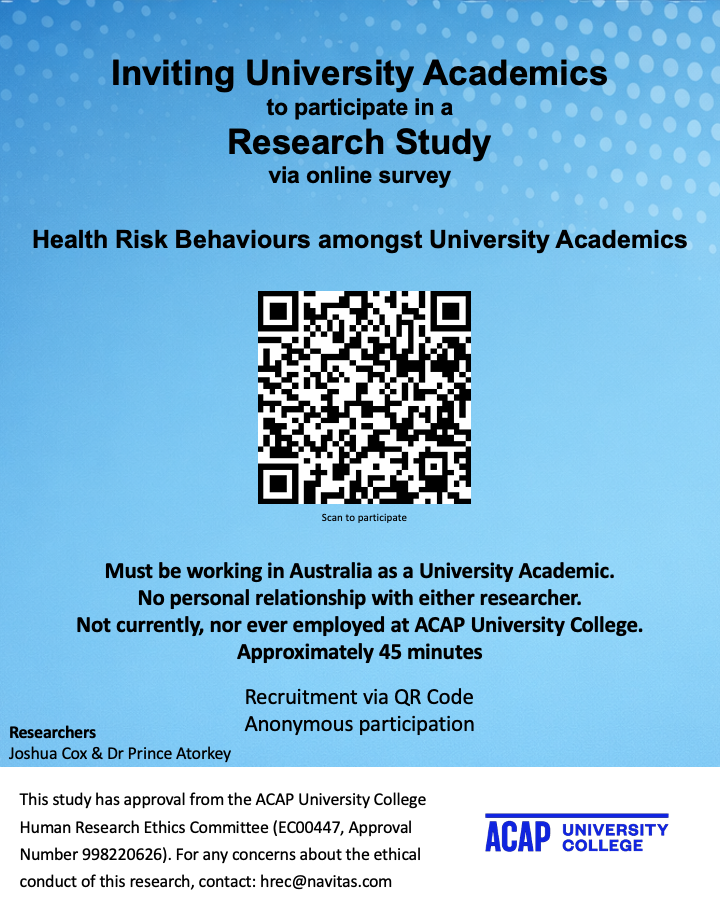
Behavioural Clustering and its Association with Psychological Distress in University Lecturers: A Cross-Sectional Analysis
ELIGIBILITY CRITERIA
Inclusion criteria:
- Currently employed in university academic roles
- No personal relationship with the researchers
- Currently living in Australia.
STUDY DESCRIPTION
University academics experience high occupational stress, which may influence their mental health. Whilst behaviours such as poor sleep or substance use are linked to psychological distress, it remains unclear whether risk is better explained by isolated or broader behavioural lifestyles. This study examines whether behavioural profiles are associated with psychological distress in university academics. It is hypothesised that maladaptive behavioural patterns and accumulated unhealthy behaviours will be associated with higher distress. G*Power analyses indicate 300 participants for a cross-sectional online survey, including measures of psychological distress, sleep quality, physical activity, substance use, and diet. Cluster analysis will identify behavioural profiles, followed by regression modelling to examine associations with distress. Findings may clarify whether behavioural patterns provide a stronger explanation of distress than isolated behaviours, and may inform wellbeing interventions. Cluster-derived behavioural profiles and a cumulative behavioural risk index will enter regression models to examine relative associations with psychological distress.
NAMES OF INVESTIGATORS
Joshua Cox & Prince Atorkey
HREC APPROVAL NUMBER
This research has been approved by the ACAP University College HREC (EC00447) (Approval Number: 998220626). For concerns about ethical aspects of this research, please contact the ACAP HREC: [email protected].
SURVEY LINK
https://qualtricsxm2yrccy34y.qualtrics.com/jfe/form/SV_9G2oN57163tTQO2
PROJECT END DATE
1 December 2026
Download here
BACK TO TOP
The Role of Moral Disengagement in the Link Between Masculinity Beliefs and Online Aggressive Behaviour
ELIGIBILITY CRITERIA
To complete this survey, we ask that you are:
- A man or male identified person
- 18 years and older
- Residing in Australia
- Able to read and understand English well enough by your own assessment to complete an online survey in English
- Not in a personal relationship with any of the researchers.
STUDY DESCRIPTION
In this study, beliefs about masculinity refers to strong or rigid ideas about how men should think, feel, and behave, especially when these ideas are linked to hostility towards women and harmful behaviour towards oneself or others. Gender-based online aggression refers to hostile, intimidating, deceptive, destructive, or antisocial behaviour directed at a woman or groups of women in online spaces. Justifying harmful behaviour refers to the ways a person may explain or excuse harmful actions to themselves, so they do not feel shame or guilt. Should you choose to participate in this study, you will complete an online survey comprising 55 questions, including questions about your sex, gender, and age. The survey should take no more than 30 minutes to complete.
NAMES OF INVESTIGATORS
Dr. Aileen Luo and Ms. Grace Bowland
HREC APPROVAL NUMBER
This research has been approved by the ACAP University College HREC (EC00447) (Approval Number: 992140626). For concerns about ethical aspects of this research, please contact the ACAP HREC: [email protected].
SURVEY LINK
https://acap.au1.qualtrics.com/jfe/form/SV_3UaZVuEqNrqdGV8
PROJECT END DATE
September 2026
BACK TO TOP
Living with Psoriatic Arthritis: A Qualitative Exploration of Female Identity in Established Adulthood
ELIGIBILITY CRITERIA
- Women assigned female at birth
- Aged 30 years+
- Residing in Australia
- Who were diagnosed with Psoriatic Arthritis between the ages of 30 and 45
Participants must be able to speak and read English well enough by their own assessment and have no relationship with either researcher.
STUDY DESCRIPTION
We are conducting research on the lived experiences of women diagnosed with Psoriatic Arthritis. Participation involves a 45 – 60 minute online interview.
NAMES OF INVESTIGATORS
Nicole Mead & Marlee King
HREC APPROVAL NUMBER
This research has been approved by the ACAP University College HREC (EC00447) (Approval Number: 1001250626). For concerns about ethical aspects of this research, please contact the ACAP HREC: [email protected].
SURVEY LINK
https://acap.au1.qualtrics.com/jfe/form/SV_b7x8ngn7omXrW0m
PROJECT END DATE
December 31 2026
BACK TO TOP
Perceptions of Mental Health and Help-Seeking Behaviours Among Young People in Rural Australia: A Qualitative Community Study in Far West NSW
ELIGIBILITY CRITERIA
You can take part in this research if you:
- Are 18 to 25 years old
- Have grown up in or are currently living in Broken Hill, Far West NSW
- Can speak and understand English well enough to participate in an interview
- Do not have a personal relationship with the researchers.
STUDY DESCRIPTION
Are you a young person living in Broken Hill? Let’s talk about mental health in our community.
You are invited to take part in a study exploring young people’s understandings of how mental health is viewed in Broken Hill, and the consequences this has on young people and their support-seeking behaviours. Your participation may contribute to better understandings about rural mental health and stigma, potentially helping to inform community-specific interventions to improve the mental health outcomes for young people in the Far West.
NAMES OF INVESTIGATORS
Dr. Daniel du Plooy and Miss Ella Johnson
HREC APPROVAL NUMBER
This research has been approved by the ACAP University College HREC (EC00447) (Approval Number: 986140626). For concerns about ethical aspects of this research, please contact the ACAP HREC: [email protected].
SURVEY LINK
https://acap.au1.qualtrics.com/jfe/form/SV_ernsFlK0Unr28rI
PROJECT END DATE
December 31 2026
BACK TO TOP
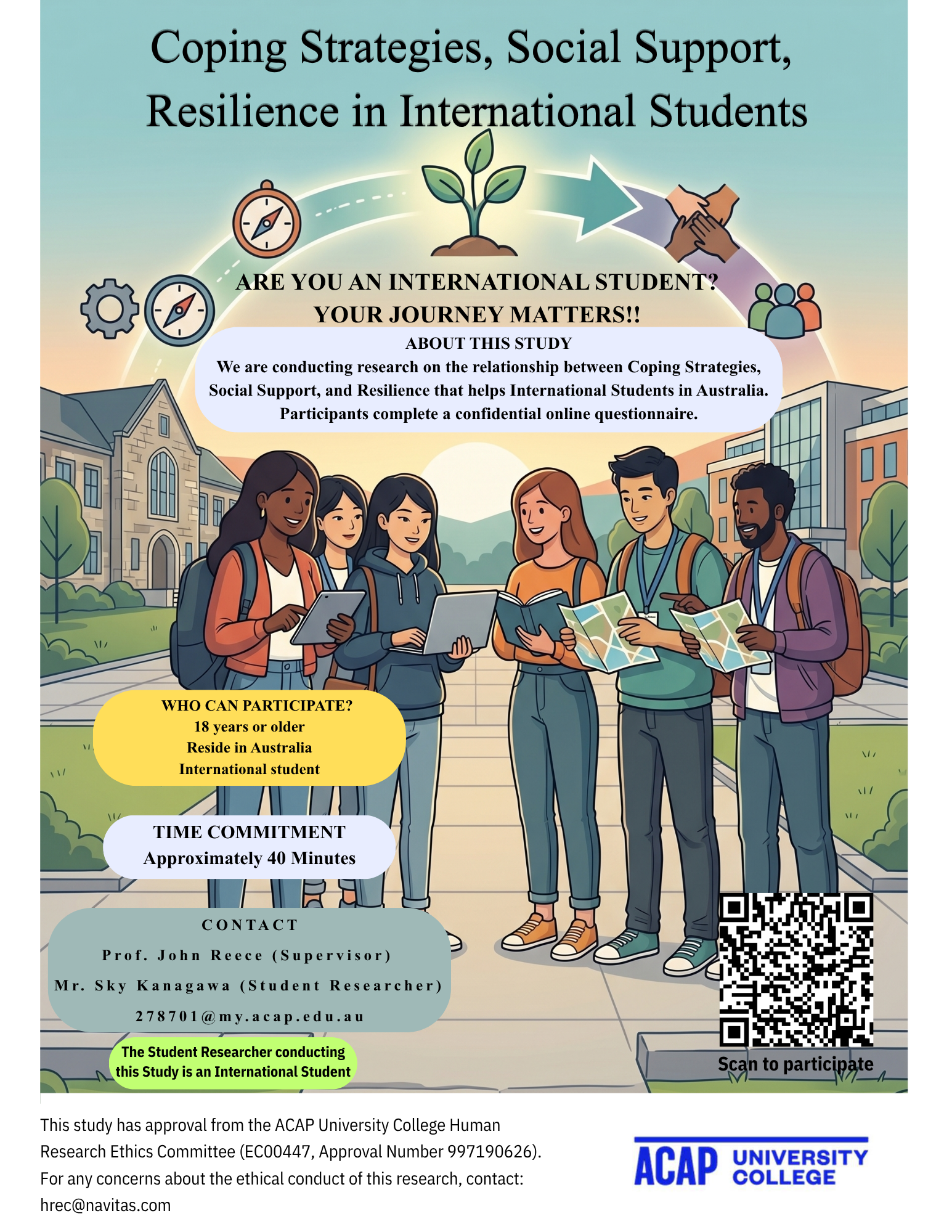
The Moderating Role of Cultural Orientation on the Relationship Between Coping Strategies, Social Support, and Resilience in International Students
ELIGIBILITY CRITERIA
To complete this survey, we ask that you:
- Are 18 years or older
- Reside in Australia
- International student currently enrolled with an Australian higher education provider
- Read and understand English well enough by my own assessment to complete a survey in English
- Do not have a personal relationship with any of the researchers.
STUDY DESCRIPTION
This research explores the psychological factors that help international students in Australia manage the stress of moving and studying abroad. It focuses on how cultural orientation, social support, and different coping strategies impact a student’s resilience.
About 100 international tertiary students will participate by completing an anonymous online questionnaire. The study aims to determine if cultural orientation, such as valuing group connections versus individual independence, influences how students use social support and coping mechanisms to build resilience.
The results may help inform the development of targeted mental health services for international students.
NAMES OF INVESTIGATORS
Hotinpo (Sky) Kanagawa, Prof. John Reece
HREC APPROVAL NUMBER
This research has been approved by the ACAP University College HREC (EC00447) (Approval Number: – ). For concerns about ethical aspects of this research, please contact the ACAP HREC: [email protected].
SURVEY LINK
https://acap.au1.qualtrics.com/jfe/form/SV_eRu7jdFx5G6quO2
PROJECT END DATE
November 2026
Download here
BACK TO TOP
Offender Cultural Background and Public Responses to Juvenile Crime in Australia
ELIGIBILITY CRITERIA
You can take part in this research if you:
- Are 18 years or over
- Are English speaking
- Reside in Australia and have no connection to the researchers.
STUDY DESCRIPTION
Recognising the influence of public attitudes on youth justice policy, the proposed study examines the influence of juvenile offender cultural background on public fear, anger, empathy, and punitiveness. Approximately 200 participants will read a crime scenario committed by a juvenile offender of First Nations, Asian Australian or White Australian background, before completing four attitude measures. Differences between cultural groups are expected owing to perceptions of realistic threat. Compared to the White Australian offender, First Nations and Asian Australian offenders are anticipated to elicit higher fear, anger, and punitiveness, and lower empathy, with the First Nations offender eliciting the highest and lowest levels, respectively. Fear and anger are expected to be more strongly related to punitiveness than empathy, with anger being the most strongly related to punitiveness. The findings may inform reporting of juvenile crime and support community diversity and inclusion efforts.
NAMES OF INVESTIGATORS
Dr Rachel MAUNDER (Supervisor/Chief Investigator) and Cara LEGGETT (Student Researcher)
HREC APPROVAL NUMBER
This research has been approved by the ACAP University College HREC (EC00447) (Approval Number: 964211225). For concerns about ethical aspects of this research, please contact the ACAP HREC: [email protected].
SURVEY LINK
https://acap.au1.qualtrics.com/jfe/form/SV_54oxudhSk8DnpTE
PROJECT END DATE
December 21, 2026
BACK TO TOP
Attitudes toward Mental Health and Help-Seeking Intention
ELIGIBILITY CRITERIA
You can take part in this research if you:
- Are 18 years and older
- Speak English well enough by your own assessment to complete a survey in English
- Reside in Australia
- Have a mental health and/or neurodevelopmental condition
- Have no personal relationship with the researchers.
STUDY DESCRIPTION
You are invited to take part in a study that explores mental health attitudes and help-seeking.
This research is conducted by Mr. Zain Rasool under the supervision of Senior Lecturer, Dr. Rachel Maunder of the Discipline of Psychological Science at ACAP University College. Zain is completing his research as part of his BPsychSci(H) degree at ACAP University College.
If you decide that you would like to take part, you will complete one of the following tasks
- Watch a short, two-minute video about a person’s mental health journey
- Complete a short, computer-based task about help-seeking (this is capped at 15 minutes)
- Read a short story (473 words, estimated two minutes to read).
You will be asked one question about the task you do. You will also answer demographic questions on age, gender, ethnicity and your mental health condition (12 questions), and survey questions on attitudes toward mental health and help-seeking (20 questions).
Time Commitment: 30 minutes
Clicking the link will take you to the survey.
NAMES OF INVESTIGATORS
Dr. Rachel Maunder and Mr. Zain Rasool
HREC APPROVAL NUMBER
This research has been approved by the ACAP University College HREC (EC00447) (Approval Number: 987140626). For concerns about ethical aspects of this research, please contact the ACAP HREC: [email protected].
SURVEY LINK
https://acap.au1.qualtrics.com/jfe/form/SV_bvfgtGvr7sA2kPc
PROJECT END DATE
May 2027
BACK TO TOP
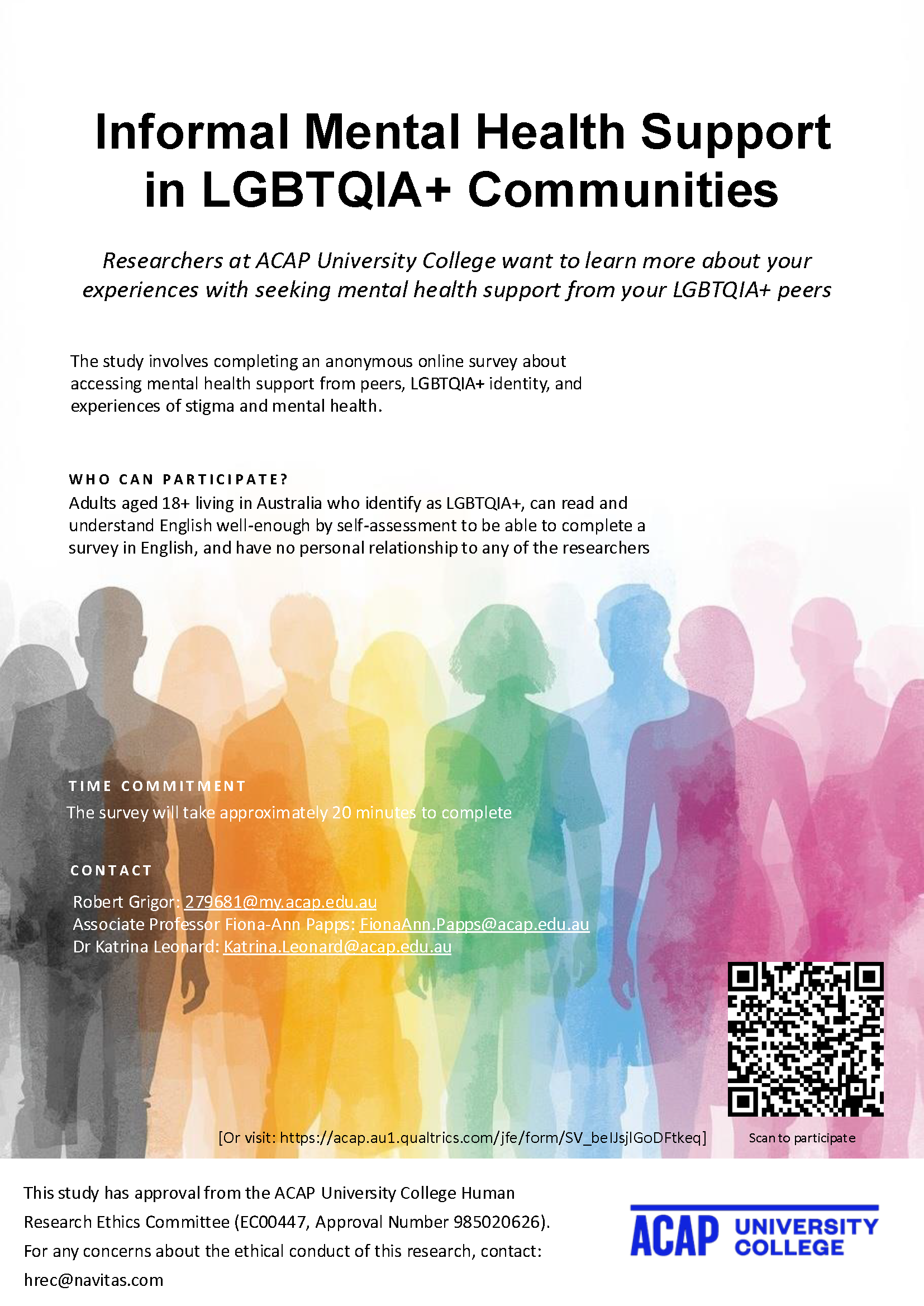
Relationships Among Identity Importance and Salience, Informal Mental Health Support, and Distress in LGBTQIA+ Communities
ELIGIBILITY CRITERIA
To complete this survey, we ask that you:
- An adult aged 18+ living in Australia who identify as LGBTQIAt
- Can read and understand English well-enough by self-assessment to be able to complete a survey in English
- Have no personal relationship to any of the researchers
STUDY DESCRIPTION
Despite increased risk of mental ill health among LGBTQIA+ folks compared to the general population, many LGBTQIA+ individuals encounter difficulties when accessing formal services due to discrimination and lack of cultural competence. There has therefore been a growing interest in informal mental health support, support accessed through social connections, in the LGBTQIA+ community. Qualitative research suggests that aspects of LGBTQIA+ identity impact informal mental health support, but these relationships, and their effects on mental health have yet to be assessed quantitatively. Using a correlational design and data gained from online surveys with a minimum of 160 LGBTIQA+ participants, this research explores relationships among minority stress, informal mental health support, identity importance and salience, and mental health outcomes. Results will contribute to an understanding of how LGBTQIA+ identity impacts the way that individuals seek out informal mental healthcare from their peers, informing clinical practice in culturally responsive care for LGBTQIA+ communities.
NAMES OF INVESTIGATORS
Robert Grigor, Fiona-Ann Papps, Katriona Leonard
HREC APPROVAL NUMBER
This research has been approved by the ACAP University College HREC (EC00447) (Approval Number: 985020626). For concerns about ethical aspects of this research, please contact the ACAP HREC: [email protected].
SURVEY LINK
https://acap.au1.qualtrics.com/jfe/form/SV_beIJsjlGoDFtkeq
PROJECT END DATE
August 31 2026
Download here
BACK TO TOP
AI Attachment Strength as a Moderator of Relational AI Use and Mental Health Outcomes
ELIGIBILITY CRITERIA
To complete this survey, we ask that you are:
- Aged 18 or over and have used conversational AI (e.g. ChatGPT, Replika, Claude) for emotional support, companionship, personal disclosure, or guidance at least once in the last 30 days.
- Do not use AI exclusively for work or study
- Do not have a personal relationship with the researchers
STUDY DESCRIPTION
This study investigates whether attachment bond quality, rather than frequency of use, accounts for heterogeneous mental health outcomes among Australians who use conversational AI for emotional support. Using the newly validated AI Attachment Scale (AIAS), this research examines relational AI use through an attachment theory framework. Open to Australians aged 18 or over who have used conversational AI (e.g. ChatGPT, Replika, Claude) for emotional support, companionship, or personal guidance at least once in the last 30 days.
NAMES OF INVESTIGATORS
Honey Chester, Dr Daniel du Plooy
HREC APPROVAL NUMBER
This research has been approved by the ACAP University College HREC (EC00447) (Approval Number: 981310526). For concerns about ethical aspects of this research, please contact the ACAP HREC: [email protected].
SURVEY LINK
https://acap.au1.qualtrics.com/jfe/form/SV_b7cYuvAJ7WwCx5c
PROJECT END DATE
December 31 2026
Download here
BACK TO TOP
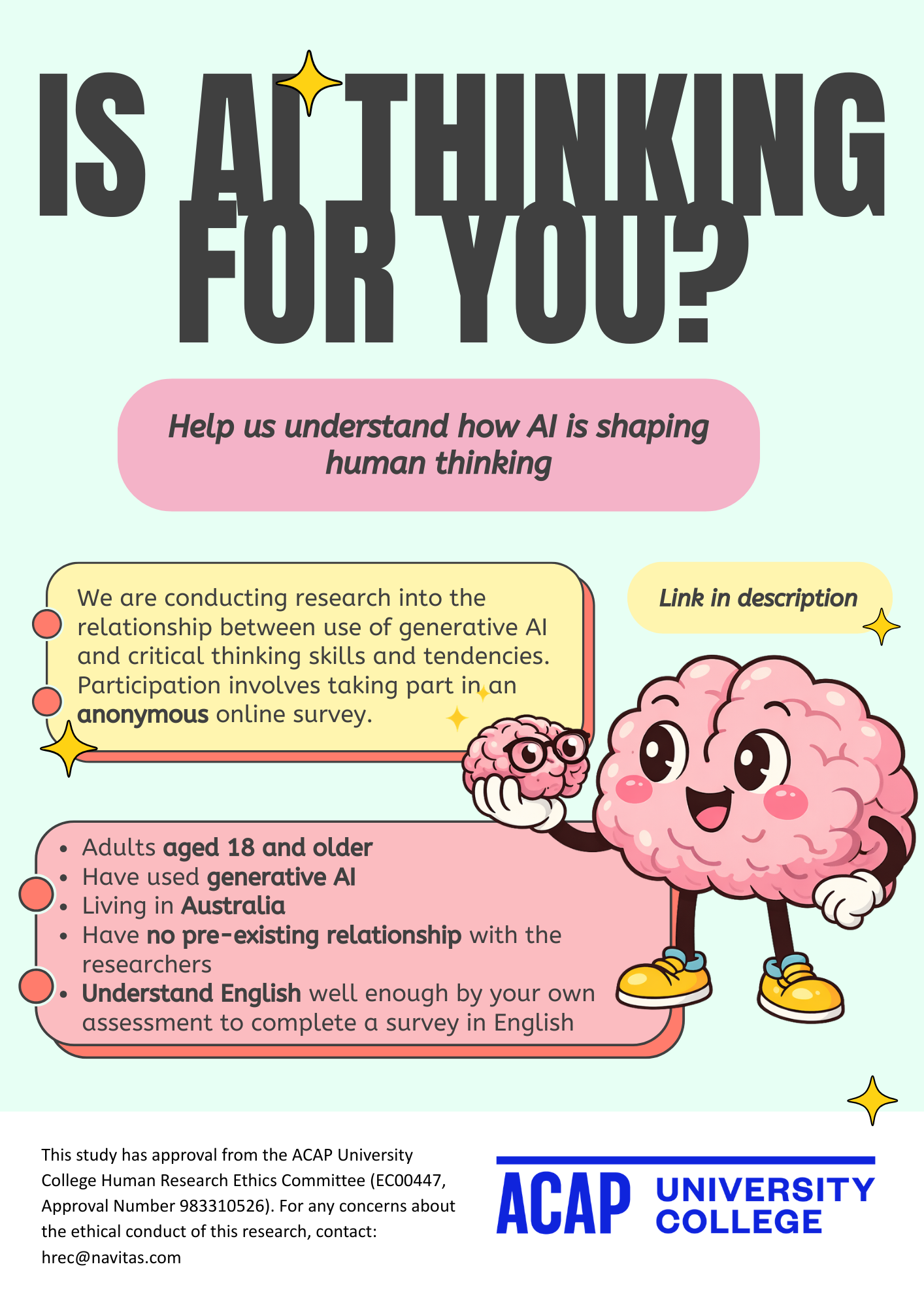
The Cost of Convenience: Conditional Pathways Linking Generative Artificial Intelligence Use to Critical Thinking via Cognitive Offloading
ELIGIBILITY CRITERIA
To complete this survey, we ask that you are:
- Have used generative artificial intelligence.
- Are aged 18 years and older.
- Are residing in Australia.
- Are able to read and understand English well enough by own assessment to complete an online survey in English.
- Are not in a personal relationship with any of the researchers.
STUDY DESCRIPTION
You are invited to take part in a study that explores how use of generative artificial intelligence affects critical thinking. We define critical thinking as the intentional use of mental skills to reach a desired outcome when solving problems or making evaluations, for example, analysing information and questioning assumptions. Your responses may add to our knowledge about the ways in which generative artificial intelligence use impacts critical thinking, and whether certain personal characteristics (such as attitudes towards effortful thinking) strengthen or weaken this relationship. These findings could inform educators, policymakers, and business leaders on best practice for integrating generative artificial intelligence tools responsibly into learning environments and workplaces, at a time when these technologies are becoming increasingly embedded in everyday life.
Importantly, this study does not assess intelligence or cognitive ability. Rather, it focuses on everyday thinking styles, habits, and preferences in how people engage with information and problem-solving. Individual differences in these areas are expected and valued, as they provide meaningful insight into how people interact with these technologies.
NAMES OF INVESTIGATORS
Miss Imogen Mijatovic & Dr. Tony Jinks
HREC APPROVAL NUMBER
This research has been approved by the ACAP University College HREC (EC00447) (Approval Number: 983310526). For concerns about ethical aspects of this research, please contact the ACAP HREC: [email protected].
SURVEY LINK
https://acap.au1.qualtrics.com/jfe/form/SV_8ByzpICp0n7W8Ga
PROJECT END DATE
November 2026
Download here
BACK TO TOP
Academic Self-Confidence
ELIGIBILITY CRITERIA
To complete this survey, we ask that you are:
- 18 years and older.
- Enrolled in an Australian college or University studying a discipline in health or social services.
- Able to read and understand English well enough by your own assessment to complete an online survey in English.
STUDY DESCRIPTION
As a student. do you question your academic abilities?
We are conducting research into the relationship between motivation, resilience, feelings of anxiety and stress, and how this relates to academic self-confidence. You are invited to participate in our research. We are surveying students enrolled in a health, or social service degree. Both undergraduates and post-graduate students are invited to participate.
NAMES OF INVESTIGATORS
Alison Bremner, Dr Jemma Harris
HREC APPROVAL NUMBER
This research has been approved by the ACAP University College HREC (EC00447) (Approval Number: 984010626). For concerns about ethical aspects of this research, please contact the ACAP HREC: [email protected].
SURVEY LINK
https://acap.au1.qualtrics.com/jfe/form/SV_87FiVzDVfp3r4RU
PROJECT END DATE
17 August 2026
Download here
BACK TO TOP
An Investigation of Functional Social Support Types on Parental Stress and Self-Efficacy and the Moderating Influence of Number and Age of Children
ELIGIBILITY CRITERIA
You may be eligible to participate if you are:
- 18 years or older
- A current parent or primary caregiver of at least one child under 18 years of age
- Reside in Australia
- Are able to read and understand English well enough by their own assessment to complete a survey in English
- Have no personal relationship with any member of the research team.
STUDY DESCRIPTION
Parenthood is a period of perpetual challenge and change. While social support has been consistently linked to improved parental outcomes, it is unclear whether all modes of social support can be considered equal. This study aims to examine the relative influence of each mode on parental self-efficacy and stress, and if these relationships are moderated by years of parenting experience and number of children. It is hypothesised that emotional and informational support will account for the greatest variance in both stress and self-efficacy, and evidence of moderation will be found. Surveys will be distributed via social media to present a demographic questionnaire and three scales reflecting functional social support, parental self-efficacy, and parental stress. A desired outcome of the research is a greater understanding of how to most effectively support parents based on their individual factors.
NAMES OF INVESTIGATORS
Dr Staci Vicary & Ms Jaki Barnes
HREC APPROVAL NUMBER
This research has been approved by the ACAP University College HREC (EC00447) (Approval Number: 976080526). For concerns about ethical aspects of this research, please contact the ACAP HREC: [email protected].
SURVEY LINK
https://acap.au1.qualtrics.com/jfe/form/SV_cw2XYB0RPsMnb9Q
PROJECT END DATE
May 31, 2027
BACK TO TOP
Living with Dissociative Identity Disorder in Australia: A Phenomenological Study of Mental Health Care Experiences
ELIGIBILITY CRITERIA
You can take part in this research if you:
- Have received a professional (not self) diagnosis of dissociative identity disorder.
- Reside in Australia.
- Are 18 years and older.
- Speak and read English well enough by your own assessment to complete a verbal interview and read a transcript in English.
- Have no personal relationship with the researchers.
- Are not under any guardianship arrangement.
- Have not been subject to involuntary psychiatric treatment.
- Have not have experienced clinically significant symptoms (e.g., significant distress or significant impairment) for a period of six months.
STUDY DESCRIPTION
Dissociative identity disorder is the severest of dissociative disorders, characterised by disruptions to cognitive processes, perception, consciousness and identity. Dissociative identity disorder can result from severe and repeated childhood abuse, where separate self-states, involving amnesia, emerge to cope with overwhelming trauma. Dissociative identity disorder is a contentious condition, often misdiagnosed or unidentified. In Australia, inadequate education, training and clinical skills in relation to identification and treatment contributes to barriers to informed treatment for people with dissociative identity disorder. Given these limitations and a dearth of lived experience research, in this research, six people with self-reported diagnoses of dissociative identity disorder will be interviewed about their lived experience with mental health services in Australia. Verbatim transcripts will be analysed using interpretative phenomenological analysis. Results may contribute insights into experiences of mental health services in Australia for people with dissociative identity disorder.
NAMES OF INVESTIGATORS
Associate Professor Fiona Ann Papps and Kirrilee Price
HREC APPROVAL NUMBER
This research has been approved by the ACAP University College HREC (EC00447) (Approval Number: 979150526). For concerns about ethical aspects of this research, please contact the ACAP HREC: [email protected].
SURVEY LINK
https://pdflink.to/9f0d5b02/
PROJECT END DATE
December 31, 2026
BACK TO TOP
The Impact of Connections and Values on Mental Health
ELIGIBILITY CRITERIA
You may be eligible to participate if you:
- Currently reside in Australia.
- Are 18 years and older.
- Know someone who has a mental health condition.
- Are able to read and understand English well enough by self-assessment to complete an online survey English.
- Have no personal relationship with any member of the research team.
STUDY DESCRIPTION
This research study is looking at how people are affected when someone close to them has a mental health condition. It is exploring whether these experiences are influenced by how close someone is to the individual with a mental health condition, and by the values they hold about independence and group belonging which can play a role in these experiences.
NAMES OF INVESTIGATORS
Dr. Rachel Maunder and Ms. Silsla Seddiqi
HREC APPROVAL NUMBER
This research has been approved by the ACAP University College HREC (EC00447) (Approval Number: 952120925). For concerns about ethical aspects of this research, please contact the ACAP HREC: [email protected].
SURVEY LINK
https://acap.au1.qualtrics.com/jfe/form/SV_0jEbXeT8EMkP0k6
PROJECT END DATE
August 2026

Download here
BACK TO TOP
PAST & COMPLETED STUDIES
View the past and completed studies below.
ELIGIBILITY CRITERIA
N/A
PROJECT SUMMARY
Significant overlap exists between groups of sex workers and individuals with neurodivergence, disability, and/or chronic illness. This may partly reflect the flexibility and adaptability of sex work compared with many non-sex work occupations. However, research on sex work has often been reductive, focusing primarily on violence, morality, and health risks. Studies frequently rely on convenience samples and rarely centre the voices of sex workers themselves, which limits insight into their experiences. While some scholarship has begun to recognise the accessibility that sex work may provide, this area of research remains underdeveloped. Online forums provide spaces where individuals discuss their experiences without researcher prompting, offering additional insight into how disability and employment barriers intersect with participation in sex work. This study examines how neurodivergent, disabled, and chronically ill adults describe sex work as an alternative to conventional employment in online discussions, particularly in relation to structural exclusion and workplace accessibility.
NAMES OF INVESTIGATORS
Susan Abel
HREC APPROVAL NUMBER
This research has been approved by the ACAP University College HREC (EC00447) (Approval Number: 988140626). For concerns about ethical aspects of this research, please contact the ACAP HREC: [email protected].
PROJECT END DATE
13 October 2026
ELIGIBILITY CRITERIA
You can participate in the study if:
- You are a parent or primary caregiver of a child aged 5 to 8 years who is currently in formal primary schooling.
- Your child has attended long daycare, family daycare, or preschool before entering primary school.
- You are 18 years and older.
- You are residing in Australia.
- You are able to read and understand English well enough by your own assessment to complete an online survey in English.
- You are willing to answer questions about your previous experience in your child’s long daycare, family daycare, or preschool.
- You are willing to answer questions about your child’s social and emotional well-being.
PROJECT SUMMARY
Young children’s social and emotional wellbeing develops through the everyday relationships around them, and for many Australian children, two of the most important settings are home and early childhood education and care. Bronfenbrenner’s ecological systems theory suggests that what matters is not only what happens within each setting, but the quality of the connection between them — the space where families and educators relate. When caregivers and educators know each other and communicate openly, children move between home and care with more consistency and security. Yet most research in this area has focused on school-age children, on settings outside Australia, or on family involvement activities rather than the quality of the relationship itself. This study set out to address that gap.
One hundred and one Australian primary caregivers completed an online survey rating the quality of their relationship with their child’s educator, and separately reporting on their child’s social and emotional strengths and difficulties. The relationship measure captured three distinct parts: educators’ attitudes (warmth, respect and openness toward the family), educators’ knowledge of the child and family, and educators’ practices (the concrete things they do to involve and communicate with families). The social and emotional scale measured children’s prosocial behaviour, hyperactivity, and emotional, peer, and conduct problems.
Caregivers who reported a better overall relationship with their child’s educator also reported that their child showed more prosocial behaviour and fewer social and emotional difficulties overall. Educators’ attitudes were the strongest and most consistent predictor, linked to fewer emotional problems, fewer behavioural problems and fewer difficulties with peers. Educators’ knowledge of the child and family was linked to more prosocial behaviour. Educators’ practices were not significantly linked to any of the child outcomes measured, and no aspect of relationship quality predicted hyperactivity and inattention.
The pattern suggests that how educators relate to families may matter more for children’s wellbeing than the formal mechanisms of family engagement. Educators’ relational capability, and working conditions that allow unhurried contact with families, may be a meaningful way to support children’s wellbeing. Because everything was measured at a single point in time and reported by caregivers alone, the findings cannot show that better relationships cause better outcomes. Future longitudinal work, including educators’ perspectives, may provide a deeper understanding of the topic.
NAMES OF INVESTIGATORS
Louise Taguinod Ong (Student) and Dr Staci Vicary (Supervisor)
HREC APPROVAL NUMBER
This research has been approved by the ACAP University College HREC (EC00447) (Approval Number: 962201225). For concerns about ethical aspects of this research, please contact the ACAP HREC: [email protected].
PROJECT END DATE
3 August 2026
ELIGIBILITY CRITERIA
Practising career development professionals in Singapore who held a recognised career development qualification or certification, were currently working with clients, and had at least three years of professional experience in career development practice.
PROJECT SUMMARY
Careers today involve more than finding a suitable job or developing the skills needed to remain employable. People may also need to manage career change, maintain their wellbeing, find meaning in their work, prepare for uncertainty, and balance career decisions with financial, family, and other life circumstances.
This study explored how experienced career development practitioners in Singapore understand career health and how they work with clients towards healthier and more sustainable careers. Eight practitioners working across education, public, private, non-profit and independent career settings participated in individual interviews about their professional experiences.
The findings showed that practitioners viewed career health as multidimensional and changing over time, rather than something that could be judged simply by whether a person was employed or possessed relevant skills. Five interconnected areas were identified.
First, practitioners considered different aspects of a person’s career and life together, including employability, financial stability, wellbeing, relationships and personal circumstances. Second, they emphasised reflective agency, i.e. helping people understand their circumstances, recognise where choices remain available, and make intentional decisions. Third, meaning and values mattered: having a successful career externally did not necessarily mean that a person experienced their work as personally worthwhile. Fourth, career health involved preparing for change, such as continuing to learn, developing transferable skills, maintaining networks and considering alternative pathways before disruption occurs. Finally, career health was influenced by relationships and wider circumstances, including family support, employers, labour-market conditions and public policy.
Overall, the study suggests that supporting career health involves looking beyond job matching and skills development. Career practitioners may play an important role in helping people reflect on what matters to them, prepare for change, understand their options and navigate the personal and structural circumstances affecting their careers.
NAMES OF INVESTIGATORS
Dr Timothy Hsi
HREC APPROVAL NUMBER
This research has been approved by the ACAP University College HREC (EC00447) (Approval Number: 949200825). For concerns about ethical aspects of this research, please contact the ACAP HREC: [email protected].
PROJECT END DATE
Completed
ELIGIBILITY CRITERIA
Research completed. Recruitment is closed; no further participants are being sought.
PROJECT SUMMARY
People who identified more strongly with a hero’s journey reported less willingness to justify harm. This was the central finding of our study of 293 adults living in Australia, and the opposite of our prediction.
What did we study?
A hero’s journey is a way of understanding life through purpose, challenges, support from others and personal growth. We examined how this outlook relates to extremist beliefs and intentions to take radical action.
We also measured moral disengagement: the willingness to excuse harmful conduct by, for example, downplaying its consequences or shifting responsibility. Participants completed an anonymous online survey.
What did we find?
The link between a stronger hero’s journey outlook and less moral disengagement was modest. It remained after accounting for age and the tendency to give socially favourable answers.
The analysis also identified indirect links with extremist beliefs. Stronger hero’s journey identification was associated with less moral disengagement, which was itself associated with lower general extremist and right-wing radical belief scores. These combined links remained supported after a statistical adjustment for testing several relationships.
The corresponding indirect links for left-wing radical beliefs and intentions to take radical action were not supported by the same test. Once moral disengagement and the other factors were accounted for, there was insufficient evidence of an additional direct link with any of the four outcomes.
What do the findings mean?
The findings support examining how people understand their own lives alongside the ideological beliefs they hold when researching radicalisation.
Because participants were surveyed only once, we cannot establish cause and effect. The study measured reported beliefs and intentions, not actual extremist behaviour, and its volunteer sample limits how widely the findings apply. It does not establish that adopting a hero’s journey outlook prevents radicalisation.
Thank you to everyone who contributed to this ACAP University College Honours study.
NAMES OF INVESTIGATORS
Mario Norus; Professor Katarina Fritzon
HREC APPROVAL NUMBER
This research has been approved by the ACAP University College HREC (EC00447) (Approval Number: 957011025). For concerns about ethical aspects of this research, please contact the ACAP HREC: [email protected].
PROJECT END DATE
Data collection ended 13 February 2026; the project was reported complete on 24 March 2026.
ELIGIBILITY CRITERIA
To complete this survey, we ask that you:
- Reside in Australia
- Are aged 18 or over
- Have sufficient English proficiency (by your own assessment) to complete a survey in English
- Have no personal relationship with researchers.
PROJECT SUMMARY
You are invited to take part in a study that explores the role that cognitive flexibility can play in your resilience.
Participation involves completing a one-time, anonymous online survey that should take no more than 45 minutes to complete. Your responses may help to inform the design of targeted interventions and support programs that strengthen resilient outcomes through adaptive thinking and coping.
If you are a first-year student in Psychological Science at ACAP University College, you will receive one credit point for taking part.
This research is being conducted by Mrs Marita Eddy, towards their Bachelor of Psychological Science (Honours) in the Discipline of Psychological Science at ACAP University College. Mrs Marita Eddy is supervised by Professor John Reece.
NAMES OF INVESTIGATORS
Marita Eddy and John Reece
HREC APPROVAL NUMBER
This research has been approved by the ACAP University College HREC (EC00447) (Approval Number: 990140626). For concerns about ethical aspects of this research, please contact the ACAP HREC: [email protected].
SURVEY LINK
https://acap.au1.qualtrics.com/jfe/form/SV_43ljFhfHfr9XkzQ
PROJECT END DATE
August 2026
ELIGIBILITY CRITERIA
Not applicable. This project did not involve participant recruitment. It was a qualitative document analysis of published and publicly available assessment materials, peer-reviewed literature, Australian early intervention and disability policy and practice documents, and relevant Australian contextual indicators. No human participants, surveys, interviews, or private clinical records were included.
PROJECT SUMMARY
The project was completed as approved using qualitative document analysis and framework-based thematic analysis. The analysis examined Vineland-3 assessment materials, peer-reviewed literature, Australian early intervention and disability policy/practice documents, and relevant Australian contextual indicators. Five themes were identified: everyday functioning; the limits of scores when interpreted without context; the value and contextual nature of caregiver and educator reports; the use of adaptive functioning evidence to guide supports; and the importance of understanding the whole child through ecological, culturally responsive, and multidisciplinary interpretation. The findings indicate that the Vineland-3 provides a useful structure for describing adaptive functioning, but its results should not be interpreted as standalone explanations of a child’s capacity. The completed research has been written as an Honours manuscript titled “Seeing the Whole Child: Adaptive Behaviour Assessment, the Vineland-3, and Contextual Interpretation in Australian Early Childhood Practice.”
NAMES OF INVESTIGATORS
Tulin Kocacik, Dr Prince Atorkey
HREC APPROVAL NUMBER
This research has been approved by the ACAP University College HREC (EC00447) (Approval Number: 969270226). For concerns about ethical aspects of this research, please contact the ACAP HREC: [email protected].
PROJECT END DATE
21 July 2026
ELIGIBILITY CRITERIA
You may be eligible to participate if you meet all of the following criteria:
- Aged 18 years or older
- Live in Australia
- Able to participate in an interview conducted in English
- Have a self-reported formal ADHD diagnosis, received after the age of 18
- Have enrolled in tertiary study following diagnosis (e.g., university, TAFE, or other accredited post-secondary vocational training)
- Be currently enrolled in tertiary study
- Not under legal guardianship
- Have no personal relationship with the researchers.
PROJECT SUMMARY
The study explores the experiences of Australian adults who were diagnosed with Attention-Deficit/Hyperactivity Disorder (ADHD) after the age of 18 and who have since returned to tertiary study. The research aimed to understand how students make sense of their past academic experiences and how they construct and adapt their learner identity following their diagnosis. The findings may help inform post-diagnostic supports and university initiatives to better meet the needs of students with ADHD.
NAMES OF INVESTIGATORS
Victoria Leary, Dr Daniel du Plooy, Dr Gabriella Karakas
HREC APPROVAL NUMBER
This research has been approved by the ACAP University College HREC (EC00447) (Approval Number: 958201025). For concerns about ethical aspects of this research, please contact the ACAP HREC: [email protected].
SURVEY LINK
https://qualtricsxm2jy77ftyj.qualtrics.com/jfe/form/SV_aWBTMQXdRcHq5ee
PROJECT END DATE
20 July 2026
ELIGIBILITY CRITERIA
To complete this survey, we ask that you:
- Are 18 years or older
- Are a resident in Australia
- Do not have a relationship with the researchers.
SUMMARY OF RESULTS
Research Study Title: Public Perceptions of Juvenile Offending in Australia
ACAP University College HREC Approval Number: 964211225
Researcher’s Name: Cara LEGGETT, Student Researcher, Dr Rachel MAUNDER, Supervising Researcher
Researcher’s Relationship to ACAP University College: Student (Cara LEGGETT) and Employee (Dr Rachel MAUNDER)
Thank you for your interest in this research project.
This study aimed to investigate the influence of juvenile offender cultural background on public perceptions of juvenile offending in Australia.
Public perceptions of juvenile offending can shape government juvenile justice policy, such as stricter bail laws and adult sentencing lengths for more serious crimes (e.g., ‘adult crime, adult time’ and ‘tough on crime’ approaches). Punitive approaches to juvenile crime direct government spending towards youth justice centres and policing and away from rehabilitative efforts. This can have a range of adverse outcomes for juvenile offenders, including poorer education and employment outcomes. Media reports on offences committed by juveniles and references to their cultural background may influence public perceptions, and consequently government policy.
This study was interested in whether participants would respond differently to a short description of a juvenile crime depending on whether the juvenile offender had a First Nations, Asian Australian or White Australian background. Additionally, we were interested in whether participants who responded with more anger and fear and less empathy towards the offender, might also report more punitive attitudes.
To address the research goals, this study recruited 222 members of the general public over 18 years of age who resided in Australia and had no relationship to the researchers. Participants read a description of a juvenile crime before completing measures of fear of and anger about crime and empathy and punitiveness towards juvenile offenders. We found no significant differences in responses between the three cultural background conditions. However, compared to the association between empathy and punitiveness, anger and punitiveness were found more strongly and more positively associated, and fear and punitiveness more positively associated. This meant that people who felt more anger about crime were more likely to support harsher punishment for the young offender. People who felt more fear were also more likely to support harsher punishment. The link between anger and support for punishment was stronger than the link between empathy and support for less punishment.
The study may have implications for responsible reporting of juvenile crime by news and social media, community initiatives to reduce punitive attitudes through reducing fear and anger and increasing empathy, and for governmental policy.
For further information about the research project, please contact Dr Rachel Maunder at [email protected].
If you feel distressed by the results of the study, a list of free services you may like to contact is available at: https://acap.au1.qualtrics.com/jfe/form/SV_5iNotZyiOF8ZcPA
NB A pdf copy of the research project literature review and manuscipt has been submitted to: https://unilinc-acp.primo.exlibrisgroup.com/discovery/collectionDiscovery?vid=61UNI_ACP:ACP&collectionId=819693930002363
NAMES OF INVESTIGATORS
Cara LEGGETT (Student) and Dr Rachel MAUNDER (Supervisor)
HREC APPROVAL NUMBER
This research has been approved by the ACAP University College HREC (EC00447) (Approval Number: 964211225). For concerns about ethical aspects of this research, please contact the ACAP HREC: [email protected].
SURVEY LINK
https://acap.au1.qualtrics.com/jfe/form/SV_5cKFGYjDF9uHHAq
PROJECT END DATE
02 July 2026
ELIGIBILITY CRITERIA
To complete this survey, we ask that you:
- Are over 18 years of age
- Currently reside in Australia
- Work in non-clinical client facing roles e.g. hairdressers, barbers, beauticians, tattoo artists, real estate agents, and hospitality workers
- Have at least 6 months of experience in the role
- Are able to read and understand English well enough by their own assessment to complete an online survey in English; and
- Have no personal relationship with the researchers.
PROJECT SUMMARY
Secondary traumatic stress (STS) arises from indirect exposure to trauma and can produce symptoms similar to posttraumatic stress disorder (PTSD), making it an important yet often overlooked occupational risk, particularly outside clinical settings. This study addresses this gap by examining STS in non‑clinical, client‑facing professionals (such as, hairdressers, personal trainers, hospitality workers). The study investigated whether empathy mediates the relationship between unexpected client trauma disclosures and STS, and whether personality traits (neuroticism and extraversion) and work environment act as moderators. Fifty adults aged 19–68 (M = 40.22, SD = 14.10) completed an online survey. Results revealed empathy mediated the relationship between unexpected client trauma disclosures and STS, such that greater exposure increased empathy, which in turn was associated with higher STS, while no direct relationship was observed. However, moderation analyses were non‑significant, indicating that personality traits did not influence the relationship between trauma disclosure and empathy, and work environment did not influence the relationship between empathy and STS. These findings highlight empathy as a key mechanism linking everyday client interactions to distress, suggesting that non‑clinical client facing roles may carry unrecognised risk for STS. Future research should use larger and more diverse samples and examine emotional regulation and coping processes to better inform targeted workplace interventions.
NAMES OF INVESTIGATORS
Dr Charini Gunaratne
HREC APPROVAL NUMBER
This research has been approved by the ACAP University College HREC (EC00447) (Approval Number: 965221225). For concerns about ethical aspects of this research, please contact the ACAP HREC: [email protected].
SURVEY LINK
https://acap.au1.qualtrics.com/jfe/form/SV_5t0tXiTOGDNuIFU
PROJECT END DATE
30 June 2026
ELIGIBILITY CRITERIA
You can take part in this research if you:
- Currently reside in Australia
- Are at least 18 years old
- Are someone who, during their childhood or adolescence, observed a romantic relationship between their caregivers or between a caregiver and another adult (e.g. married/widowed parents, single parent and their partner, grandparents, adopted parents, foster parents, parent and step-parent)
- Are someone who is in a committed romantic relationship themselves (e.g. partners have mutually dedicated themselves to maintaining their relationship, despite exclusivity).
- Have no personal relationship with the researcher
- Are someone who demonstrate sufficient English proficiency to complete the survey Participants must have observed a romantic relation between their caregivers or between a caregiver and another adult to enable a meaningful assessment of their perceptions of parental relationship quality. Individuals who have deceased caregivers are still eligible.
STUDY DESCRIPTION
Prior literature has established that children acquire relationship skills through observing and imitating their parents’ relationship, suggesting an intergenerational transmission of relationship dynamics and quality. Research has yet to consider how individual traits, such as an individual’s locus of control, may influence this transmission. An internal locus of control, whereby individuals believe they can control their own fate, may ameliorate the transmission. This study hypothesises that perceived parental romantic relationship quality will influence an individual’s own romantic relationship quality, and this association will be moderated by locus of control. Australian adults in a romantic relationship will complete measures of perceived parental relationship quality, current romantic relationship quality, and locus of control. Hayes’ PROCESS macro will be used to test the hypotheses. Findings may advance understandings of how familial influence and individual traits interact to determine romantic relationship quality, with applications for relationship counselling and education.
NAMES OF INVESTIGATORS
Georgina Short, Dr Rachel Maunder
HREC APPROVAL NUMBER
This research has been approved by the ACAP University College HREC (EC00447) (Approval Number: 961091225). For concerns about ethical aspects of this research, please contact the ACAP HREC: [email protected].
SURVEY LINK
https://acap.au1.qualtrics.com/jfe/form/SV_bjQl9bmNfB3YTwq
PROJECT END DATE
June 22 2026
ELIGIBILITY CRITERIA
Participants were eligible to take part in the study if they:
- Identified as cisgender women
- Were 18 years or older at the time of the offence that led to their incarceration
- Were living in Australia
- Had served a sentence of imprisonment or home detention in an Australian jurisdiction.
PROJECT SUMMARY
This research explored what life is like for women in Australia after incarceration or home detention. It focused on women’s experiences of reintegration, well-being, safety, identity, and belonging after release.
Reintegration is often discussed in terms of reoffending, compliance, or individual responsibility. However, this study found that rebuilding life after punishment is much more complex. Women described facing ongoing barriers such as criminal record stigma, difficulty finding safe housing, financial stress, trauma, limited access to services, disrupted family relationships, and social judgement.
The study involved anonymous online survey responses from 15 women who had experienced incarceration or home detention in Australia. The responses were analysed to identify common patterns across women’s experiences.
The findings showed that release does not always mean punishment has ended. For many women, their criminal record continued to affect their access to housing, employment, education, banking, insurance, services, and relationships. Safe and stable housing was one of the most important foundations for rebuilding, because it supported recovery, parenting, employment, service engagement, and emotional well-being.
Women also described the importance of support that was practical, respectful, trauma-informed, non-judgemental, and based on trust. Support was most helpful when workers listened, followed through, helped with practical needs, and treated women as people rather than as risks. However, some systems intended to support reintegration were experienced as confusing, punitive, or focused on surveillance, which could increase shame and distress.
The research also found that reintegration involved trauma recovery, not only meeting conditions or avoiding reoffending. Women described the impact of domestic and family violence, anxiety, shame, addiction recovery, mental health distress, and difficulty accessing counselling. Belonging was also important. Women rebuilt identity and connection through children, family, trusted relationships, work, study, pets, sobriety, and helping others.
Overall, this research suggests that successful reintegration should not be measured only by whether women reoffend. It should also consider whether women have access to safe housing, emotional support, trauma recovery, family repair, meaningful work or study, culturally safe services, and opportunities to belong. The findings highlight the need for reintegration support that is practical, relational, trauma-informed, culturally safe, and focused on dignity, safety, and long-term well-being.
NAMES OF INVESTIGATORS
Cindy Burke – Student Researcher, Prof. Kate Fritzon – Supervising Researcher
HREC APPROVAL NUMBER
This research has been approved by the ACAP University College HREC (EC00447) (Approval Number: 967030226). For concerns about ethical aspects of this research, please contact the ACAP HREC: [email protected].
PROJECT END DATE
16 June 2026
ELIGIBILITY CRITERIA
To complete this survey, we ask that you:
- Are 18 years of age or older
- Are able to understand English well enough, by your own assessment, to understand an instructional video and complete surveys in English
- Currently reside in Australia
- Do not have a current diagnosis of post-traumatic stress disorder (PTSD)
- Are not currently experiencing unresolved trauma symptoms
- Are not in a personal relationship with any of the researchers
- Are not under legal guardianship
- Have no personal relationship with the researchers.
PROJECT SUMMARY
This study examined whether the butterfly hug, a self-administered form of tactile bilateral stimulation derived from Eye Movement Desensitisation and Reprocessing (EMDR) therapy, could facilitate flow state and promote personal growth in non-clinical adults. As the practice requires no equipment, training, or supervision, it may offer an accessible wellbeing tool for people who do not access formal mental health services.
Adults residing in Australia completed a two-part anonymous online survey separated by a seven-day butterfly tapping practice period. The final analytic sample comprised 71 complete baseline responses and 36 complete follow-up responses covering flow, personal growth, positive affect, and emotion regulation.
Post-practice state flow was significantly higher than baseline dispositional flow (p = .008), with a medium effect size (d = 0.53). However, tapping frequency and state flow did not significantly predict personal growth, and flow did not significantly moderate the tapping–growth relationship, although several associations pointed in the theorised direction. Flow and personal growth were both significantly associated with positive affect.
These findings offer preliminary evidence that butterfly tapping may be associated with elevated flow, supporting its promise as a low-cost wellbeing practice. Larger longiditunal studies that track change within individuals are needed before conclusions about bilateral stimulation having an affect on personal growth can be drawn.
NAMES OF INVESTIGATORS
Erdem Karabulut & Associate Dr Christopher Holt
HREC APPROVAL NUMBER
This research has been approved by the ACAP University College HREC (EC00447) (Approval Number: 970270226). For concerns about ethical aspects of this research, please contact the ACAP HREC: [email protected].
SURVEY LINK
https://acap.au1.qualtrics.com/jfe/form/SV_9YbFJEnsAel2joa
PROJECT END DATE
12 June 2026
ELIGIBILITY CRITERIA
To complete this survey, we ask that you:
- Were 18 years and older
- Currently reside in Australia
- Were able to read and understand English well enough by their own assessment to complete an online survey in English
- Do not have a current diagnosis of post-traumatic stress disorder (PTSD)
- Are not currently experience symptoms of unresolved trauma
- Were not in a personal relationship with any of the researchers.
STUDY DESCRIPTION
Research substantiates the wellbeing impacts associated with flow, an absorbed, optimal psychological state theorised to promote personal growth over time. One potential pathway to flow is the butterfly hug, a self-administered form of bilateral stimulation derived from Eye Movement Desensitisation and Reprocessing (EMDR) that requires no equipment, training, or supervision. This study examined whether a seven-day butterfly tapping practice was associated with higher flow, whether tapping frequency and flow predicted personal growth, and whether flow moderated the tapping-growth relationship.
Participants completed a two-part anonymous online survey. Baseline measures assessed dispositional flow before the practice period, and follow-up measures assessed state flow, personal growth, positive affect, acceptance, and positive reappraisal after seven days of self-paced tapping.
The results demonstrated that post-practice state flow was significantly higher than baseline dispositional flow. Tapping frequency was not significantly associated with personal growth, state flow did not significantly predict personal growth, and state flow did not moderate the tapping-growth relationship. Although constrained by the small follow-up sample and the adapted growth measure, these findings provide preliminary evidence that butterfly tapping may be associated with elevated flow.
NAMES OF INVESTIGATORS
Erdem Karabulut & Associate Dr Christopher Holt
HREC APPROVAL NUMBER
This research has been approved by the ACAP University College HREC (EC00447) (Approval Number: 970270226). For concerns about ethical aspects of this research, please contact the ACAP HREC: [email protected].
SURVEY LINK
https://acap.au1.qualtrics.com/jfe/form/SV_eRu7jdFx5G6quO2
PROJECT END DATE
06 June 2026
ELIGIBILITY CRITERIA
To complete this survey, we ask that you:
- Are 18 years or older
- Migrated to Australia
- Are proficient enough in English to complete an online survey in English by your own assessment
- Have no pre-existing relationship with the researcher.
PROJECT SUMMARY
This study aimed to investigate the psychosocial mechanisms—specifically perceived social support and acculturation strategies—that differentiate positive from poor quality of life outcomes among migrants experiencing elevated acculturative stress.
The transition to a new host country is a significant life event marked by unique stressors and challenges, including the need to navigate complex structural landscapes, overcome language barriers, and adapt to new cultural norms. While migration is universally recognised as a stressful experience, the psychological impact varies significantly; some individuals demonstrate robust resilience, while others experience poor adaptational outcomes. Understanding the specific factors that promote resilience is crucial, as shifting from a “deficit-based” focus on psychological consequences toward a “strengths-based” framework helps identify actionable traits that actively promote well-being.
This study was interested in whether a migrant’s specific acculturation strategy (how they balance their heritage culture with the host society’s expectations) and their levels of perceived multidimensional social support (from family, friends, and significant others) could predict resilient outcomes. Additionally, we were interested in comparing individuals who face high equivalent levels of migration adversity to see which psychosocial factors differentiate successful adaptation from poor expected outcomes.
To address the research goals, this study recruited 176 migrants residing in Australia who completed self-report measures assessing immigration stress, quality of life, social support, and acculturation. Focusing on a targeted subsample of 87 participants who reported high levels of migration stress, we compared a “Resilient” group (high stress, high wellness) with a “Poor Expected” group (high stress, low wellness). We found that the Resilient cohort reported significantly stronger social support networks overall. Specifically, feeling supported by friends and family significantly decreased the odds of poor adaptation. Furthermore, individuals who actively engaged with the mainstream culture (an Assimilation strategy) had significantly reduced odds of experiencing poor outcomes compared to those who felt disconnected from both their heritage and host cultures (a Marginalisation strategy).
The study may have implications for how settlement policies are designed, demonstrating that high acculturative stress does not inevitably diminish a migrant’s quality of life. The findings suggest that settlement programs should extend beyond logistical assistance to actively foster peer-to-peer social networks and host-culture engagement to promote functional resilience.
NAMES OF INVESTIGATORS
Manoj Dharmaraj, John Reece
HREC APPROVAL NUMBER
This research has been approved by the ACAP University College HREC (EC00447) (Approval Number: 968210126). For concerns about ethical aspects of this research, please contact the ACAP HREC: [email protected].
SURVEY LINK
https://acap.au1.qualtrics.com/jfe/form/SV_4I6GtdnSLwb6yZo
PROJECT END DATE
30 May 2026
ELIGIBILITY CRITERIA
You can take part in this research if you:
- Are an individual who migrated to Australia by choice, who are originally from Southeast and Central Asia, Sub-Saharan and North Africa, Eastern Europe, Middle East, Central and South America
- Are 18 years and older
- Have no personal relationships with the researchers
- Currently reside in Australia
STUDY DESCRIPTION
A qualitative study that draws upon narrative exposure therapy was conducted to facilitate storytelling and exploration of existential concerns of migrants originating from countries that do not fit the Western, Educated, Industrialized, Rich, Democratic (WEIRD) classification. The overall aim of the study was to explore the existential concerns of migrants to Australia, the strategies used to navigate these concerns, and the meaning-making process they engage in during their acculturation process.
Twenty-one semi-structured interviews have been conducted either face-to-face or online. Ten of the participants have been supported by a certified interpreter to participate in an interview in English. A modified version of the lifeline technique, with participants chronologically mapping meaningful positive and negative events from their migration experiences was used. The interviews were audiotaped and transcribed using Otter.ai. Reflexive thematic analysis was used to analyse the data, with NVivo 15 supporting the generation of initial codes and the identification of emerging themes.
Preliminary findings indicate several key themes, including (1) migrating in search of better opportunities, freedom of choice and safety from conflict and violence; (2) facing adversity while adjusting to a new country triggered a sense of existential isolation; (3) English as a language barrier triggered a sense of social isolation, but not existential isolation; (4) Covid lockdown as a barrier to physically caring and being present for loved ones in critical moments; (5) migration as a source of self-growth and personal discovery; (6) meaning or purpose in life as a unifying process that fueled perseverance and resilience; (7) variations in self-construal influenced the content of life narratives.
The present findings highlight a shift in migration motives, suggesting that while migration has traditionally been driven by economic and employment-related reasons, existential motives are becoming increasingly prominent. The existential concerns that appeared to cause considerable distress were existential isolation and a loss of meaning in life. Notable variations in self-construal were also observed, even among individuals from the same country, influencing the content of their life narratives.
NAMES OF INVESTIGATORS
Dr Alice-Viviana Bercean, Michaela Boyce, Dr Kathryn Morris-Roberts, Dr Nathan Beel, Asmina Kakshapati, Dr Paul McQuillan
HREC APPROVAL NUMBER
This research has been approved by the ACAP University College HREC (EC00447) (Approval Number: 920150525). For concerns about ethical aspects of this research, please contact the ACAP HREC: [email protected].
SURVEY LINK
https://www.linkedin.com/in/alice-bercean/recent-activity/all/
PROJECT END DATE
May 2027
ELIGIBILITY CRITERIA
You may be able to participate if you:
- Aged 18 years of age or older
- A parent or caregiver of at least one child who is under the age of 18 years old and currently lives at home
- Resides in Australia
- Able to read and understand English well enough by own assessment to complete an online survey in English
- Not in a personal relationship with either of the researchers
STUDY DESCRIPTION
This study examines the relationship between work arrangement congruence and parental burnout in Australian parents. Specifically, it investigated whether alignment between parents’ preferred and actual work arrangements such as remote, hybrid, or onsite employment affects levels of emotional exhaustion, depersonalisation, and personal accomplishment. Using a cross-sectional survey design, 295 parents provided demographic, occupational, and burnout-related data. A two-way mixed ANOVA was conducted.
Results indicated significant main effects of congruence, suggesting that greater alignment between preferred and actual work conditions was associated with lower burnout scores. No significant interactions between work type and congruence were observed, potentially reflecting limited statistical power for detecting small effects.
NAMES OF INVESTIGATORS
Claudia Lamberto, Dr Larissa Clarkson
HREC APPROVAL NUMBER
This research has been approved by the ACAP Human Research Ethics Committee (EC00447) (Approval Number: 955240925).
For concerns about ethical aspects of this research, please contact the ACAP HREC: [email protected].
PROJECT END DATE
02 March 2026
SURVEY LINK
https://acap.au1.qualtrics.com/jfe/form/SV_50VEsx2TWsnCHFI
ELIGIBILITY CRITERIA
To complete this survey, participants must:
- Have been in a romantic relationship in which gaslighting was experienced
- Currently be in a different romantic relationship
- Be over 18 years of age
- Currently reside in Australia
- Be able to read and understand English well enough by their own assessment to complete an online survey in English.
- Have no personal relationship with any member of the research team.
STUDY DESCRIPTION
You are invited to take part in a study that is exploring how the experience of gaslighting in a previous relationship is perceived to have affected current personal and relationship well-being through the mechanism of self-concept clarity. Gaslighting is a relational dynamic in which one person repeatedly manipulates another, causing them to question their thoughts, memories, perceptions, and even their own mental stability. The experience of gaslighting, then, may affect the extent to which we possess a clearly defined and stable sense of self, which in turn may affect our own subsequent personal well-being and the well-being of any later relationships. Although gaslighting is increasingly recognised in media and public awareness campaigns, there is little research on how it affects both self-identity, life meaning, and later romantic relationship experiences. This study seeks to better understand these effects by hearing directly from adults who may have experienced gaslighting from a romantic partner.
NAMES OF INVESTIGATORS
Christina Samios & Erin Nasir
HREC APPROVAL NUMBER
This research has been approved by the ACAP Human Research Ethics Committee (EC00447) (Approval Number: 954230925).
For concerns about ethical aspects of this research, please contact the ACAP HREC: [email protected].
PROJECT END DATE
March 2026
SURVEY LINK
https://acap.au1.qualtrics.com/jfe/form/SV_em4zDwJWh3rIVXE
ELIGIBILITY CRITERIA
You may be able to participate if you:
- Are 18 years or older
- Are able to read and write in English well enough by own assessment to play an online game and complete surveys written in English
- Currently reside in Australia
- Have no personal relationship with the researchers
STUDY DESCRIPTION
This study is investigating how personality traits and online environments affect gaming performance. In particular, we’re interested in how competitive environments help shape our ability to perform under pressure against an opponent and how that might change our behavioural perception. Little is currently known about how these traits and changes in environment influence performance.
This research study is being conducted at ACAP University College by Mr. James Harding and is being supervised by Dr. Haruka Kitamura (Discipline of Psychology).
If you agree and consent to take part, you will access the study on Qualtrics. You’ll first receive instructions for how to play Tetris and then complete a 30-second practice round. You’ll then play three games of Tetris against a real, anonymous opponent, report how you feel, and answer questions about yourself and your personality.
The study will take approximately 35 – 50 minutes.
Completing the study on mobile is currently unavailable. Please use a laptop or desktop computer.
NAMES OF INVESTIGATORS
Dr. Haruka Kitamura, and James Harding
HREC APPROVAL NUMBER
This research has been approved by the ACAP Human Research Ethics Committee (EC00447) (Approval Number: 930050625).
For concerns about ethical aspects of this research, please contact the ACAP HREC: [email protected].
PROJECT END DATE
01 January 2026
SURVEY LINK
https://acap.au1.qualtrics.com/jfe/form/SV_3ykfflWf9nguPs2
ELIGIBILITY CRITERIA
You may be able to participate if you:
- Are a mother of at least one male or a male-identified person aged between 12 to 15 years who lives with you at least 50% of the time
- Are proficient enough in English by self-assessment to complete an interview and check the subsequent transcript
- Reside in Australia
- Have no relationship with the researcher or supervisor
STUDY DESCRIPTION
Male body image dissatisfaction and body dysmorphic disorder are increasing in prevalence, with young men particularly at risk. Although mothers are key body-image socialisation agents, the voices of the mothers themselves have yet to be heard. Given that mothers are potential witnesses of changes to their adolescent son’s bodies, social media use, relationships and appearance-enhancement behaviours, their perspective may provide valuable insights. This qualitative study explored what mothers perceived their role to be in their adolescent son’s body image socialisation. Six mothers (Mage = 50.67) of adolescent sons were recruited through purposive sampling supplemented by snowball referrals. Verbatim transcripts from semi-structured interviews were analysed using thematic analysis.
Analysis generated two key themes: People and Spaces. People described as influential in their sons’ body image socialisation were linked to their sons’ life stage, with the sons themselves, siblings, and peers identified as direct influences. Participants perceived their own and paternal influence as being indirect, except when concerns for their sons’ health or appearance behaviour arose. Participants also perceived the spaces occupied by sons, such as schools, gyms, and social media, to be significant influences, providing opportunities for autonomous exploration of appearance free from adult supervision. Findings suggest that developing clinical interventions aimed at body image dissatisfaction in adolescent males need to recognise boys themselves as active socialisation agents and focus on critical media literacy. Psychoeducation for mothers that teaches warning signs of body image concerns based on life stage development may also encourage early intervention.
NAMES OF INVESTIGATORS
Jaclyn Folpp & Fiona Ann Papps
HREC APPROVAL NUMBER
This research has been approved by the ACAP Human Research Ethics Committee (EC00447) (Approval Number: 932100625).
For concerns about ethical aspects of this research, please contact the ACAP HREC: [email protected].
PROJECT END DATE
31 December 2025
SURVEY LINK
https://www.facebook.com/share/15rT1TCnZu/?mibextid=wwXIfr
ELIGIBILITY CRITERIA
You may be eligible to participate if you:
- Are aged 18 years and older
- Currently reside in Australia
- Speak English well enough by self-assessment to read and answer a survey in English
- Are a student enrolled in Australian education
- Have no personal relationship with the researchers.
STUDY DESCRIPTION
You are invited to take part in a study exploring daily pressures, stress and well-being in Australian students. The research is also interested in exploring whether different types of social support have any impact on well-being, and what that impact might be. Your participation may also contribute to future implementation of practical solutions and contribute to further research on the topic in the broader literature.
If you choose to take part, you will complete a 25-minute survey via Qualtrics Software, which can be completed via a laptop, desktop computer or a mobile phone.
Participation is voluntary.
If you are a first-year Psychological Science student at ACAP University College, you may receive credit points for research participation.
NAMES OF INVESTIGATORS
Dr Tony Jinks and Susan Del Nevo
HREC APPROVAL NUMBER
This research has been approved by the ACAP Human Research Ethics Committee (EC00447) (Approval Number: 953190925).
For concerns about ethical aspects of this research, please contact the ACAP HREC: [email protected].
PROJECT END DATE
December 12, 2025
SURVEY LINK
https://acap.au1.qualtrics.com/jfe/form/SV_eE8urUzLl7XURsq
ELIGIBILITY CRITERIA
You may be eligible to participate if you:
- Are 18 years or older
- Are the current or ex-partner of an ADF member who has deployed on, and returned from ADF operations for greater than three months at least once in their career.
- Were in a relationship with the member during and immediately after the deployment.
- The member must be currently serving or has recently separated from the ADF within the last 24 months.
- At the time of the deployment, you must have normally lived with the member when they were not deployed.
- Are able to read and write in English well enough by own assessment.
- Currently reside in Australia.
- Have no personal relationship with the researchers.
STUDY DESCRIPTION
Ambiguous loss is chronic unresolved grief arising when a loved one is physically missing but psychologically present, or vice versa. Military partners frequently encounter ambiguous loss due to prolonged separations during deployments, yet there are no scales to measure this experience. Participants will complete an online survey via Qualtrics including the 36 candidate items. An exploratory factor analysis will aim to categorise these items into factors that, when combined, will create a psychometric scale to assess perceptions of ambiguous loss among partners of ADF members when deployed operations. It is expected that the proposed scale will include five factors and will correlate negatively with relationship satisfaction and family resilience, and positively with perceived stress. It is expected that this research will provide a better understanding of the impact ambiguous loss has on partners and may allow clinicians to implement more targeted interventions and support options.
NAMES OF INVESTIGATORS
Jordan Manie, Dr Christopher Holt
HREC APPROVAL NUMBER
This research has been approved by the ACAP Human Research Ethics Committee (EC00447) (Approval Number: 922190525).
For concerns about ethical aspects of this research, please contact the ACAP HREC: [email protected].
PROJECT END DATE
December 2025
SURVEY LINK
https://acap.au1.qualtrics.com/jfe/form/SV_4N3ay8899mnol6e
ELIGIBILITY CRITERIA
Participants:
- Were 18 years and older.
- Indicated they resided in Australia.
- Were able to read and understand English well enough by their own assessment to complete an online survey in English.
- Were not in a personal relationship with any of the researchers.
STUDY DESCRIPTION
Research substantiates the wellbeing impacts associated with meaning in life. One of the pathways to meaning is through reminiscence – the recollection of autobiographical memories. This study examined the relationship between autobiographical memory functions – the purposive, adaptive reasons that people think and talk about their personal memories – and meaning in life, then assessed whether savouring mediated this relationship.
Participants completed measures of autobiographical memory functions (self-continuity, social-bonding, and directing-behaviour), savouring (anticipatory savouring, savouring in the moment, and reminiscence savouring), and meaning in life (comprehension, purpose, mattering, and significance).
The results demonstrated significant positive relationships between autobiographical memory functions variables and meaning in life variables. Savouring was found to partially mediate the relationship between autobiographical memory functions, and comprehension and purpose. It was found to fully mediate the relationship between autobiographical memory functions, and mattering and significance. Although cross-sectional, the results are helpful in that a link has been established between more frequent thinking and talking about autobiographical memories – and savouring the process of doing so – and having a greater sense of meaning in life.
NAMES OF INVESTIGATORS
Donna Radley & Associate Professor Christina Samios
HREC APPROVAL NUMBER
This research has been approved by the ACAP Human Research Ethics Committee (EC00447) (Approval Number: 934110625).
For concerns about ethical aspects of this research, please contact the ACAP HREC: [email protected].
PROJECT END DATE
11 December 2025
SURVEY LINK
https://acap.au1.qualtrics.com/jfe/form/SV_e4h7caodSoZcpQq
ELIGIBILITY CRITERIA
You may be eligible to participate if you:
- Are 18 years or older
- Reside in Australia
- Read and understand English well enough by their own assessment to complete a survey in English
- Do not have a personal relationship with any of the researchers
STUDY DESCRIPTION
You are invited to take part in a study that explores the universality of inner speech and its potential influence on the Big Five personality traits (Extraversion; Neuroticism; Openness; Agreeableness; Conscientiousness) and life satisfaction – which has yet to be empirically investigated. This study will explore whether there are personality differences between individuals who do or don’t have inner speech, and whether life satisfaction plays a role in these differences. This research could facilitate our understanding on whether personality affects inner speech and, consequently, life satisfaction. Our research could lead to more tailored therapeutic strategies, aimed at enhancing psychological wellbeing by targeting our unique cognitive processes.
NAMES OF INVESTIGATORS
Sophie Nishijima
HREC APPROVAL NUMBER
This research has been approved by the ACAP Human Research Ethics Committee (EC00447) (Approval Number: 938180625).
For concerns about ethical aspects of this research, please contact the ACAP HREC: [email protected].
PROJECT END DATE
December 2025
SURVEY LINK
https://acap.au1.qualtrics.com/jfe/form/SV_82OmpMmvneyS56e
ELIGIBILITY CRITERIA
Participants were eligible to take part if they were 18 years or older, had remained unvaccinated against COVID-19, and were living in Australia during the pandemic. They also needed to be able to participate in an interview conducted in English, provide informed consent, and have no personal relationship with the researchers.
STUDY DESCRIPTION
The COVID-19 pandemic reshaped public health and social life in Australia. Vaccination status became a defining social marker and a focus of intense public narratives. Despite international evidence of stigma, exclusion, and psychological effects among unvaccinated groups, these experiences remain underexplored in the Australian context. In line with the Australian Human Rights Commission’s 2025 recommendations for fair and compassionate recovery planning, this study explored how Australians who remained unvaccinated made sense of their experiences throughout and beyond the pandemic.
Thirteen adults took part in qualitative interviews, and their stories were analysed using Reflexive Thematic Analysis to identify shared meanings. Participants described stigma, exclusion, and fractured relationships that deeply impacted their lives. Many spoke of grief and anger, intensified by feeling unable to express their views safely, while also describing moments of vindication and strength, proud of their choices yet hurt by their social cost. Beneath these reflections lay emotional distress that often surfaced only in hindsight, suggesting that the psychological impacts continue to unfold. The findings underscore the need for open dialogue and trauma-aware, inclusive recovery frameworks that acknowledge both harm and resilience within these experiences.
NAMES OF INVESTIGATORS
Renae Wagner & Daniel du Plooy
HREC APPROVAL NUMBER
This research has been approved by the ACAP Human Research Ethics Committee (EC00447) (Approval Number: 929040625).
For concerns about ethical aspects of this research, please contact the ACAP HREC: [email protected].
PROJECT END DATE
Project has ended.
SURVEY LINK
https://www.facebook.com/profile.php?id=61574935986109
ELIGIBILITY CRITERIA
You may be able to participate if you:
- Are a parent or caregiver of at least one child aged 0-18
- Live in Australia
- Are 18 years or older
- Use social media at least once a week
- Have no personal relationships with the researchers
- Understand English well enough by their own assessment to complete a survey
STUDY DESCRIPTION
This project examined how upward social comparison on social media affected parenting self-efficacy among Australian parents, and whether social media literacy moderated or improved these effects. Drawing on Bandura’s self-efficacy theory and Festinger’s social comparison theory, the study investigated how curated online environments shaped parents’ beliefs in their ability to parent effectively.
A cross-sectional online survey was conducted between June and August 2025 with Australian parents of children aged 0–18 who used social media at least weekly. Participants completed validated measures including the Parental Social Media Comparison Scale (PSMC), the Measure of Parenting Self-Efficacy (MaaP), and the Parental Social Media Literacy Scale (PSML), as well as demographic items. Data cleaning, dummy-coding, Little’s MCAR testing, multiple imputation, hierarchical regression, and moderation analysis (PROCESS Model 1) were undertaken to address the research questions.
The findings indicated that upward social comparison was associated with lower parenting self-efficacy, suggesting that exposure to idealised online portrayals diminished parents’ confidence. In contrast, social media literacy emerged as an independent positive predictor of parenting self-efficacy, indicating that parents who better understood the constructed nature of online content reported greater confidence. However, social media literacy did not moderate the association between upward comparison and parenting self-efficacy.
Overall, the project contributed to understanding how social media shaped parental self-beliefs and demonstrated that while upward comparison negatively influenced parenting confidence, social media literacy provided its own positive effect. These insights were intended to inform parenting programs, online wellbeing education, and public health communication strategies.
NAMES OF INVESTIGATORS
Dr Timea Partos & Ms. Negin Salehi
HREC APPROVAL NUMBER
This research has been approved by the ACAP Human Research Ethics Committee (EC00447) (Approval Number: 937170625).
For concerns about ethical aspects of this research, please contact the ACAP HREC: [email protected].
PROJECT END DATE
28 November 2025
SURVEY LINK
https://acap.au1.qualtrics.com/jfe/form/SV_bsFV2bHonX3b4y2
ELIGIBILITY CRITERIA
To participate in this study, you need to be:
- An ACAP student
- Over 18 years old
- Residing in Australia
- Proficient in English by self assessment – can read questions and write responses in an online survey
STUDY DESCRIPTION
Noncommunicable diseases were deemed a “challenge of epidemic proportions” in 2011 by United Nations. They account for 74% of all deaths globally, and are responsible for nine out of the top ten causes of death in Australia. Extensive research has attributed noncommunicable diseases to four major preventable health risk behaviours: smoking, harmful use of alcohol, unhealthy diet and physical inactivity. This study conducted a thematic analysis of 102 qualitative survey responses from Australian university college students, where coding was informed by the COM-B framework to examine how individual capabilities, opportunities, and motivations influence engagement in health risk behaviours.
Although most students are aware of the harmful consequences, many continue to engage in health risk behaviours. For smoking and harmful alcohol use, key barriers to change include their role in social settings and their use as maladaptive coping mechanisms. For unhealthy diets and physical inactivity, key barriers to change include time constraints and financial limitations. Conversely, the key facilitators of healthy lifestyle choices include a strong desire to maintain health, and the ability to plan and integrate healthy habits into daily routines and social situations to support long term healthy lifestyle changes. These findings offer deeper insights into the drivers of health risk behaviours in Australian university college students, which will inform future development of effective behaviour change interventions to reduce health risk behaviours associated with the development of noncommunicable diseases and premature death.
NAMES OF INVESTIGATORS
Ingrid Chan & Prince Atorkey
HREC APPROVAL NUMBER
This research has been approved by the ACAP Human Research Ethics Committee (EC00447) (Approval Number: 905191024).
For concerns about ethical aspects of this research, please contact the ACAP HREC: [email protected].
PROJECT END DATE
Project already completed.
SURVEY LINK
https://acap.au1.qualtrics.com/survey-builder/SV_5iiS4PDL1R1Qd2C/edit
ELIGIBILITY CRITERIA
To participate in this study, you need to be a parent or primary carer of a child currently attending primary school in Australia, be 18 years or older, reside in Australia, have no personal relationship with any of the researchers, and be able to, by your own evaluation, read and understand English well enough to complete an online survey on your own.
STUDY DESCRIPTION
Although understanding parental attitudes (parent defined as any primary caregiver) is crucial for fostering inclusive education, there is limited knowledge about the factors that influence parental support for school programs about gender and sexual diversity in Australian primary schools. These programs aim to teach students to respect and understand the variety of gender identities and sexual orientations beyond traditional norms.
This study examines how personal beliefs, such as having connections to gender and sexually diverse individuals, perceptions that these programs improve student wellbeing, concerns about whether they might confuse children, and whether they are age-appropriate, shape parental support. The study also investigates the role of broader attitudes, such as a preference for traditional values and social order and views on maintaining social hierarchies in shaping these attitudes.
NAMES OF INVESTIGATORS
Dr Tony Jinks & Nigel Hunt
HREC APPROVAL NUMBER
This research has been approved by the ACAP Human Research Ethics Committee (EC00447) (Approval Number: 913191224).
For concerns about ethical aspects of this research, please contact the ACAP HREC: [email protected].
PROJECT END DATE
November 2025
SURVEY LINK
https://acap.au1.qualtrics.com/jfe/form/SV_aaAekJAEnKbeTCC
ELIGIBILITY CRITERIA
You may be eligible to participate if you:
- Remained unvaccinated against COVID-19
- Are 18 years of age and older
- Currently reside in Australia and resided in Australia during the pandemic
- Are able to participate in an interview conducted in English
- Have no personal relationship with the researchers.
STUDY DESCRIPTION
You are invited to take part in a study exploring the lived experiences of people who remained unvaccinated against COVID-19 both during and since the pandemic. Your participation may contribute to a better understanding of these experiences and support future conversations.
NAMES OF INVESTIGATORS
Daniel du Plooy and Renae Wagner
HREC APPROVAL NUMBER
This research has been approved by the ACAP Human Research Ethics Committee (EC00447) (Approval Number: 929040625).
For concerns about ethical aspects of this research, please contact the ACAP HREC: [email protected].
PROJECT END DATE
October 2025
SURVEY LINK
https://acap.au1.qualtrics.com/jfe/form/SV_6gxaGN1ixy9GaSa
ELIGIBILITY CRITERIA
To complete this survey, we ask that you:
- Are over the age of 18
- Reside in Australia
- Are able to read and understand English well enough by your own assessment to complete a survey in English
- Reside in Australia
- Have no personal relationship with any of the researchers
- Have at least one experience of déjà vu in you lifetime
STUDY DESCRIPTION
Although déjà vu is commonly used to describe repetitive situations and the sensation of familiarity in unfamiliar situations, there is little research that explores its impact on psychological well-being, specifically through the lens of individual personality factors such as trait openness and spirituality. Historically, we have viewed the déjà vu experience as a pathological dysfunction or psychiatric disorder which has fostered a negative stigma within society. Modern research suggests that health and social science practitioners should employ a person-centred, holistic approach to treatment, considering a person’s physical, emotional, social, and spiritual well-being to promote human flourishing. This research will add to our knowledge about roles of trait openness and spirituality within the déjà vu-psychological well-being relationship, particularly as protective factors for psychological well-being.
NAMES OF INVESTIGATORS
Dr Tony Jinks and Ms Grace Bowland
HREC APPROVAL NUMBER
This research has been approved by the ACAP Human Research Ethics Committee (EC00447) (Approval Number: 909171224).
For concerns about ethical aspects of this research, please contact the ACAP HREC: [email protected].
PROJECT END DATE
October 2025
SURVEY LINK
https://acap.au1.qualtrics.com/jfe/form/SV_0IpmfyuzaNhJkj4
ELIGIBILITY CRITERIA
To complete this survey, we ask that you:
- Are over the age of 18
- Identify as sexuality and/or gender diverse
- Are in, or have been in, an intercultural relationship of at least 6 months
- Reside in Australia
- Have no personal relationship with Lizzy Georgopoulos or Mick Weston
- Speak and understand English well enough by your own assessment to complete an interview in English.
STUDY DESCRIPTION
This research project aims to explore how sexuality and gender diverse individuals in intercultural relationships cultivate relationship satisfaction while navigating the dual challenges of cultural differences and minority stress. Sexuality and gender diverse intercultural relationships face unique challenges stemming from differing cultural values as well as the stress of discrimination or marginalisation related to sexual or gender identity. Despite existing research on intercultural and sexuality and gender diverse relationships, their intersection remains underexplored.
This study addresses the research question: How do sexuality and gender-diverse individuals in intercultural romantic relationships negotiate challenges and differences in their relationship to strengthen relationship satisfaction? A qualitative approach will be employed, guided by an interpretivist epistemology and a constructionist ontology. The Intersectionality Theory (Crenshaw, 2013) and the Sound Relationship House Theory (Navarra & Gottman, 2015) will underpin the understanding of the intersection of minority stress and cultural value differences, helping to examine the vulnerability factors and protective factors that shape individuals’ stress responses and overall impact on relationship satisfaction. A Thematic Analysis will be employed to explore participants’ experiences of managing relationship challenges associated with cultural differences and minority stress impacts. Through purposive sampling and snowballing, six participants will be selected, and data will be collected via semi-structured interviews on Zoom.
The findings may offer valuable insights into the unique dynamics of sexuality and gender diverse intercultural relationships, the intersection of challenges between minority stress and cultural differences and factors that support the cultivation of relationship satisfaction despite these challenges. These insights may inform furture research that targets psychological support through an increased understanding of unique relational stressors experienced in this population group and, protective negotiation stratagies that help to navigate such stressors.
NAMES OF INVESTIGATORS
Micheal Weston and Elizabeth Georgopoulos
HREC APPROVAL NUMBER
This research has been approved by the ACAP Human Research Ethics Committee (EC00447) (Approval Number: 910171224).
For concerns about ethical aspects of this research, please contact the ACAP HREC: [email protected].
PROJECT END DATE
September 1, 2025
SURVEY LINK
https://qr.me-qr.com/XHi5HiV6
ELIGIBILITY CRITERIA
To complete this survey, we ask that you:
- Are over the age of 18
- Reside in Australia
- Are able to read and understand English well enough by your own assessment to complete a survey in English
- Have been previously or are currently employed full-time or part-time, residing in Australia
Participants will fall into one of three work location levels:
- employees working remotely;
- onsite employees; and
- hybrid (mixed, with a minimum of two days either onsite or remote) employees
STUDY DESCRIPTION
Existing research focuses on how workplace ostracism relates to turnover intention in onsite employees. With increased remote workers post-COVID-19, how workplace location influences the relationship between workplace ostracism and turnover intention remains unknown. Additionally how organisational support and commitment influence these factors are unclear.
Data from 100 remote, onsite and hybrid (both onsite and remote) employees will be collected using an online survey to examine whether the relationship between workplace ostracism and turnover intention is stronger for remote workers compared to hybrid and onsite workers and how organisational support and organisational commitment may influence these relationships. This study aims to recognise the effects of workplace ostracism and turnover intention in varied workplace locations to assist organisations develop effective interventions and policies applicable across working environments to reduce turnover intention.
NAMES OF INVESTIGATORS
Terese Bosworth, Dr Charini Gunaratne
HREC APPROVAL NUMBER
This research has been approved by the ACAP Human Research Ethics Committee (EC00447) (Approval Number: 911181225).
For concerns about ethical aspects of this research, please contact the ACAP HREC: [email protected].
PROJECT END DATE
8th August 2025
SURVEY LINK
https://acap.au1.qualtrics.com/jfe/form/SV_5AU05jbKsosKlAq
ELIGIBILITY CRITERIA
To complete this survey, participants must:
- have been a member of a self-improvement and transformational group
- be 18 years or older
- reside in Australia
- read, write, and understand English well enough by their own assessment to complete an online written survey in English
- not have a personal relationship with the researchers
STUDY DESCRIPTION
You are invited to take part in a study that is exploring the experiences of people who were members of self-improvement and transformational groups, but who have since left the groups. Self-improvement and transformational groups are for-profit groups, where members participate in activities, techniques, rituals, and/or learning to achieve personal growth, healing, confidence, or other internal goals. Examples are Landmark Forum, breathwork groups, coaching programs, tantric sex groups, and spiritual groups. Although we have anecdotal accounts of group member experiences, there is little empirical research on the topic, especially focused on whether members felt their identity changed during group membership. This research aims to address this gap. Our research aims to explore the lived experience of people who have been members of self-improvement and transformational groups, but who have left the groups, with a focus on whether group membership may have affected identity, and if so, in what ways.
NAMES OF INVESTIGATORS
Assoc. Prof. Fiona Ann Papps and Ms. Louise Maddalena
HREC APPROVAL NUMBER
This research has been approved by the ACAP Human Research Ethics Committee (EC00447) (Approval Number: 918160525).
For concerns about ethical aspects of this research, please contact the ACAP HREC: [email protected].
SURVEY LINK
https://acap.au1.qualtrics.com/jfe/form/SV_8zWRVmg7odyPAvc
PROJECT END DATE
31 October 2025
ELIGIBILITY CRITERIA
Participant inclusion criteria are:
- Are 18 years and older.
- Are residing in Australia.
- Are able to read and understand English well enough by your own assessment to complete an online survey in English.
- Are not in a personal relationship with any of the researchers.
- Do not currently have a guardian or are under a guardianship.
- Have never been subjected to involuntary treatment.
STUDY DESCRIPTION
Love is something almost everyone experiences, but strong feelings of romantic love are sometimes confused with something more intense, called limerence. Limerence is when a person has very strong and constant feelings for another person that they perceive as being out of their control. They constantly think about another person, and strongly want this person to like them back. They feel very happy when the person gives them positive attention, and very low when they perceive that they are being rejected. This study looks at how difficult experiences in childhood might be linked to limerence later in life. We’re also interested in whether things such as feeling anxious, challenges with handling distress and managing emotions, feeling detached from the world, and sense of self-worth might affect the relationship between childhood experiences and limerence. We’re looking for approximately 124 people, 18 years and over and living in Australia to complete an anonymous survey in English about their experiences of limerence. If you’re interested, please click the survey link to find out more.
NAMES OF INVESTIGATORS
Fiona Ann Papps & Oakley Hunter
HREC APPROVAL NUMBER
This research has been approved by the ACAP University College HREC (JH03562) (Approval Number: 9250106525).
For concerns about ethical aspects of this research, please contact the ACAP HREC: [email protected].
SURVEY LINK
https://acap.au1.qualtrics.com/jfe/form/SV_eD2jJjUr5jnwZMy
PROJECT END DATE
31 October 2025
ELIGIBILITY CRITERIA
NA — project is complete.
STUDY DESCRIPTION
Limerence is a distinct, distressing cognitive-emotional state characterised by obsessive romantic preoccupation, intrusive longing, and emotional volatility. Attachment and addiction models fail to explain its developmental origins or self-regulatory role. Kohut’s self-psychology offers a novel lens, framing limerence as a maladaptive but compensatory response to early developmental ruptures and self-fragmentation in the absence of adequate regulatory capacities. This quantitative cross-sectional survey study therefore examined relationships between adverse childhood events and limerence as mediated by emotion regulation difficulty, self-fragmentation (grandiosity and idealisation), self-esteem, anxiety, and distress tolerance in a sample of 259 adults, 18 years and over, living in Australia. Results of serial mediation analyses revealed that, as predicted, adverse childhood events were directly associated with limerence and all other variables. Contrary to prediction, full mediation pathways were non-significant, although the indirect pathways between adverse childhood events and limerence as mediated by difficulty regulating emotion and self-fragmentation (grandiosity and idealisation), and as mediated by difficulty regulating emotion, idealisation, and distress tolerance, were significant. No indirect pathway including self-esteem or anxiety was significant. These findings highlight the value of a self-psychology framework in understanding limerence as a compensatory response to early developmental disruption and fragmentation of self, advancing theoretical and clinical perspectives.
NAMES OF INVESTIGATORS
Oakley Hunter and Fiona Ann Papps
HREC APPROVAL NUMBER
This research has been approved by the ACAP Human Research Ethics Committee (EC00447) (Approval Number: 925020625). For concerns about ethical aspects of this research, please contact the ACAP HREC: [email protected].
PROJECT END DATE
31st October 2025
ELIGIBILITY CRITERIA
NA — study is completed.
STUDY DESCRIPTION
Self-help groups were traditionally educational, supportive, change-oriented programs addressing a specific life problem common to all members. Self-help, however, has evolved to include self-improvement and transformational groups, many of which are part of the multibillion-dollar health and wellness industry and run for financial gain. Although these groups may foster community, belonging, and motivation, they can also promote enforced conformity and employ exploitative leadership or business practices that pose risks to vulnerable members. Using a theoretical framework informed by the social identity approach model and a qualitative design informed by a critical realist position, the current research explored the experiences of former members of self-improvement and transformational groups. Thematic analysis of qualitative online survey responses from 16 participants demonstrated that experiences in self-improvement and transformational groups either supported growth and purpose-oriented change or no change post membership. Growth and purpose-oriented change arose from both “cures” (positive experiences of belonging and community) and “curses” (negative experiences of unethical leadership and business models, insularity, and forced conformity), whereas, for some who reported no growth, change that occurred within the group could not be maintained upon leaving due to lack of self-efficacy or to the absence of community. Results point to the utility of the social identity approach model in explaining experiences within self-improvement and transformational groups, emphasising the complex interplay between individuals and groups in shaping outcomes. Future research could use in-depth interviews or narrative methods to obtain a richer picture of the lived experiences of group members.
NAMES OF INVESTIGATORS
Louise Maddalena and Fiona Ann Papps
HREC APPROVAL NUMBER
This research has been approved by the ACAP Human Research Ethics Committee (EC00447) (Approval Number: 918160525). For concerns about ethical aspects of this research, please contact the ACAP HREC: [email protected].
PROJECT END DATE
Project is now complete.
ELIGIBILITY CRITERIA
Nil — project is complete.
STUDY DESCRIPTION
Hashimoto’s thyroiditis (HT) is a common autoimmune disease primarily diagnosed in women. Symptoms of fatigue, weight changes, and skin issues, can cause the bodies of women with HT to deviate from cultural ideals for femininity and able-bodiedness, disrupting embodied well-being. Furthermore, psychological symptoms attached to HT, such as anxiety and depression, and challenges obtaining a diagnosis and treatment can exacerbate these disruptions. Using a qualitative design grounded in phenomenology and the framework of the developmental theory of embodiment, the present research explored how living with HT influences embodied experiences in young women. From interpretative phenomenological analysis of verbatim interview transcripts conducted with six young women, three themes were identified: living with disease, social impacts, and the medical management journey. Findings support the utility of the developmental theory of embodiment in accounting for the experiences of women living with bodily differences, such as those related to HT, but also point to the need to extend the framework by highlighting how illness itself can act as an internal corset that constrains bodily freedom. This study contributes to expanding feminist embodiment theory by showing how chronic illness shapes women’s relationships with their bodies and environments.
NAMES OF INVESTIGATORS
Tenika French and Fiona Ann Papps
HREC APPROVAL NUMBER
This research has been approved by the ACAP Human Research Ethics Committee (EC00447) (Approval Number: 916010525). For concerns about ethical aspects of this research, please contact the ACAP HREC: [email protected].
PROJECT END DATE
Project is now complete.
ELIGIBILITY CRITERIA
Eligible participants must be assigned biologically female at birth, born and currently living in Australia and have at least one parent who is an immigrant (i.e. born outside Australia). They must be over the age of 18, fluent in English and have been diagnosed with PCOS, Endometriosis or any other gynaecological disorder by a medical professional.
STUDY DESCRIPTION
This qualitative study explores how second-generation women in Australia understand and navigate their experiences of Polycystic Ovary Syndrome (PCOS) and endometriosis. Despite their high prevalence, these conditions are frequently underdiagnosed and poorly managed, with systemic delays and cultural stigma contributing to diagnostic and care barriers. Using an intersectionality framework, this study examined how structural, cultural, and social factors shape women’s engagement with healthcare and their everyday lives. Semi-structured interviews were conducted with six second-generation women diagnosed with PCOS or endometriosis, and the data was analysed using Braun and Clarke’s reflexive thematic analysis. Four major themes were identified: (1) Cycle syncing for daily functioning, (2) Silencing and struggles for legitimacy in healthcare, (3) Stigma, silence, and social invalidation, and (4) Identity challenges and emotional exhaustion. Findings highlight that structural healthcare barriers, such as diagnostic delays, symptom dismissal, and limited patient-centred care, were central challenges. Cultural expectations remained present but were less explicitly enforced, indicating a generational shift in how stigma operates alongside systemic pressures. Supportive workplace environments emerged as protective factors, while digital tools such as ChatGPT were used to fill gaps in medical support. These findings underscore the need for early symptom recognition, improved healthcare communication, flexible workplace policies, and integrated structural and culturally responsive approaches. By centring the voices of second-generation women, this study contributes new insights to an under-researched area and points toward pathways for more equitable and supportive healthcare.
NAMES OF INVESTIGATORS
Azrin Rahman and Dr. Marlee King
HREC APPROVAL NUMBER
This research has been approved by the ACAP Human Research Ethics Committee (EC00447) (Approval Number: 924270525). For concerns about ethical aspects of this research, please contact the ACAP HREC: [email protected].
PROJECT END DATE
27th October 2025
ELIGIBILITY CRITERIA
N/A – research complete
STUDY DESCRIPTION
Problematic substance use harms individuals, families, societies, and economies. Recovery processes aim to address an individual’s substance use and enhance their quality of life. Although recovery treatments show moderate success, there is room for the development of complementary approaches. Tai Chi, a movement-based mind-body practice that is safe, adaptable, and non-stigmatising, demonstrates significant benefits for those with substance use disorders. However, there is little research on how Tai Chi might benefit those in recovery from self-identified problematic alcohol use. This study explored how Tai Chi was understood to contribute to recovery from problematic alcohol use. Participants were five men engaged in non-clinical community-based Tai Chi practice in Australia. Using interpretative phenomenological analysis, the study examined how participants perceived Tai Chi to support their recovery process. The analysis identified two related group experiential themes. Structure described how Tai Chi steadied recovery through connection, attentional focus, and bodily awareness, while Function captured its role in sustaining motivation and meaning, allowing recovery to be lived as continuing growth rather than abstinence alone. The study offers a practice-based view of recovery that foregrounds experiential processes supporting change. Viewed through the lens of recovery capital, Tai Chi was understood to build human, social and cultural resources while illustrating recovery as an adaptive, lived process rather than the accumulation of discrete assets. These findings highlight the value of accessible, community-delivered, movement-based mind-body practices as complementary or self-directed resources that can sustain meaningful change outside formal treatment contexts.
NAMES OF INVESTIGATORS
Arlene Liew and Associate Professor Fiona Ann Papps
HREC APPROVAL NUMBER
This research has been approved by the ACAP Human Research Ethics Committee (EC00447) (Approval Number: 871280524). For concerns about ethical aspects of this research, please contact the ACAP HREC: [email protected].
PROJECT END DATE
15th October 2025
ELIGIBILITY CRITERIA
Participants were eligible to take part if they identified as female, were aged 18 years or older, and identified as being from a Middle Eastern cultural background. Eligible participants were either born in Australia or had migrated from a Middle Eastern country but were raised within the Australian context, representing second-generation community members. To align with the study’s focus on community perceptions rather than lived experiences, individuals with a personal history of sexual violence were not included. Participants were also required to be fluent in English to ensure they could engage comfortably in the semi-structured interview process and provide informed consent.
STUDY DESCRIPTION
This study examines how second-generation Middle Eastern women in Australia understand and talk about sexual violence. It reveals that silence around these issues is often maintained by honour, shame, and patriarchal expectations that discourage disclosure. Speaking out can risk family rejection and community backlash, particularly when abuse involves someone with social or religious authority. Despite this, participants expressed hope for change through education, open dialogue, and culturally sensitive support. The findings highlight the need for community-led approaches that challenge stigma and redefine disclosure as an act of courage, protection, and collective responsibility.
NAMES OF INVESTIGATORS
Aaliyah El-Ali
Chief Investigator: Dr Gabriella Karakas
Co-supervisor: Dr Daniel du Plooy
HREC APPROVAL NUMBER
This research has been approved by the ACAP Human Research Ethics Committee (EC00447) (Approval Number: 919150525). For concerns about ethical aspects of this research, please contact the ACAP HREC: [email protected].
PROJECT END DATE
29th September 2025
ELIGIBILITY CRITERIA
The participants consisted people who were over the age of 18, live in Australia, are proficient in English, and who have engaged or engaging in various types of sex work. Some of these types include escorts, nude dancers, OnlyFans creators, and pornography actors. Participants were required to have worked as a sex worker for at least six months over the last three years, or 2 years over the last ten years. This was to ensure experiences are recent and to minimise reliance on recall.
STUDY DESCRIPTION
Why isn’t gender diversity taught more in primary schools?
A key barrier: some parents are concerned about developmental appropriateness.
Our study asked:
- How do two belief systems—Social Dominance Orientation (preference for clear group hierarchies; resistance to equality) and Authoritarianism (strong conformity to authority, tradition, and moral order)—shape concern about these lessons?
- Does personal importance (knowing a gender-diverse person or seeing benefits for one’s child) change that?
We found:
- Both Authoritarianism and Social Dominance significantly predicted concern, with Social Dominance showing the stronger effect.
- Personal importance reduced concern more for Social Dominance than for Authoritarianism. Authoritarianism-related concerns were less responsive to contact/personal connection, reflecting a perceived threat to moral order and needing different strategies.
What could help:
- Use authority-endorsed messages (government/education departments) with clear boundaries on what is and isn’t taught.
- Lead with child safety and respect; keep lessons strictly age-appropriate.
- Equip teachers with simple, consistent scripts.
- Be transparent: share brief lesson snapshots; invite questions via Q&As and easy contact channels; include parents in reviewing materials.
- Apply moral reframing: this curriculum teaches and protects children, prevents bullying, and supports community cohesion.
NAMES OF INVESTIGATORS
Nigel Hunt & Dr Tony Jinks
HREC APPROVAL NUMBER
This research has been approved by the ACAP Human Research Ethics Committee (EC00447) (Approval Number: 913191224). For concerns about ethical aspects of this research, please contact the ACAP HREC: [email protected].
PROJECT END DATE
N/A
ELIGIBILITY CRITERIA
Students enrolled in first-year psychology units at ACAP University College were eligible to participate in the study via SONA, provided they were over 18 years old and not enrolled in a tutorial being delivered by the researcher.
STUDY DESCRIPTION
The study aimed to investigate the influence of personal narratives of mental ill-health on attitudes towards people with mental health conditions. The study is now complete; a summary of results can be accessed via the link.
NAMES OF INVESTIGATORS
Rachel Maunder
HREC APPROVAL NUMBER
This research has been approved by the ACAP Human Research Ethics Committee (EC00447) (Approval Number: 839030723).
For concerns about ethical aspects of this research, please contact the ACAP HREC: [email protected].
PROJECT END DATE
18th August 2025
ELIGIBILITY CRITERIA
The participants consisted people who were over the age of 18, live in Australia, are proficient in English, and who have engaged or engaging in various types of sex work. Some of these types include escorts, nude dancers, OnlyFans creators, and pornography actors. Participants were required to have worked as a sex worker for at least six months over the last three years, or 2 years over the last ten years. This was to ensure experiences are recent and to minimise reliance on recall.
STUDY DESCRIPTION
The research assessed the influence of different factors on how sex workers viewed themselves and the work they did. We were interested in all types of sex work, which we defined as the exchange of sex or sexually related content or services for money or goods (including but not limited to, escorts, nude dancers, OnlyFans content creators, sex phoneline operators, and pornographic models or actors). Sex work is a stigmatised profession, leading some sex workers to take on negative views about themselves and the work they did. We explored factors that might protect sex workers from internalising these views, such as whether they interact with other sex workers, have a positive attitude toward sex, and believed that society in general has a positive attitude toward sex.
NAMES OF INVESTIGATORS
Madeleine Gordon and Rachel Maunder
HREC APPROVAL NUMBER
This research has been approved by the ACAP Human Research Ethics Committee (EC00447) (Approval Number: 915140225). For concerns about ethical aspects of this research, please contact the ACAP HREC: [email protected].
PROJECT END DATE
14th August 2025
ELIGIBILITY CRITERIA
- 18 years or older
- Proficient in English
- Not in a personal relationship with any of the researchers
STUDY DESCRIPTION
A convergent parallel mixed-methods study comparing participant responses to three chatbot visual styles: no-visual, a 2D image, and a 3D animated avatar. While the quantitative data showed no significant effects overall, exploratory analysis suggested that the 3D animation condition increased perceptions of attractiveness, dependability, satisfaction, and engagement compared to no-visual chatbots.
Importantly, the qualitative findings told a richer story—users expressed emotional and ethical concerns that went beyond what standard scales could measure. These included trustworthiness, the desire for human-like connection, and worries about fairness and psychological impact.
This study highlights that visual design matters—but only when design is sophisticated enough and the task has a level of complexity. As chatbots become more integrated into mental health services, we need to prioritise not just functionality, but relational design that supports user wellbeing.
NAMES OF INVESTIGATORS
Marthinus Botha, Dr Daniel du Plooy
HREC APPROVAL NUMBER
This research has been approved by the ACAP Human Research Ethics Committee (EC00447) (Approval Number: 889020824). For concerns about ethical aspects of this research, please contact the ACAP HREC: [email protected].
PROJECT END DATE
2nd August 2025
ELIGIBILITY CRITERIA
N/A – research complete
STUDY DESCRIPTION
The decision not to have children by choice is becoming more common and visible in contemporary society. This choice challenges traditional norms and expectations around reproduction and parenthood. In pronatalist societies, where reproduction is valued and parenthood is the norm, childfree individuals often face stigma and marginalisation. This study explores how the choice to remain childfree is constructed on the social media platform TikTok. A sample of 88 videos and 440 comments was collected under the hashtags #childfree and #childfreebychoice and analysed using thematic discourse analysis. The data analysis identified three themes reflecting distinct subject positions. Firstly, the ‘naïve’ childfree individual highlights constructions of the childfree choice as temporary, misinformed, and incomplete. Next, the ‘responsible’ childfree individual captures constructions of the childfree choice as a moral and ethical act. Finally, the ‘enlightened’ childfree individual, in which the childfree choice is constructed as rational, deliberate, and autonomous. Together, these themes capture the various and interconnected ways in which the choice to remain childfree is constructed and negotiated online. The findings highlight both the persistence of stigmatising narratives, as well as the emergence of counter-discourses that empower and legitimise the childfree choice. The study highlights TikTok’s role as a platform for challenging and resisting dominant discourses and illustrates the ongoing need to challenge pronatalist norms that limit reproductive autonomy and enforce normative expectations.
NAMES OF INVESTIGATORS
Mishayla Beringer & Dr Marlee King
HREC APPROVAL NUMBER
This research has been approved by the ACAP Human Research Ethics Committee (EC00447) (Approval Number: 912181224). For concerns about ethical aspects of this research, please contact the ACAP HREC: [email protected].
PROJECT END DATE
7th July 2025
ELIGIBILITY CRITERIA
N/A – research complete
STUDY DESCRIPTION
This study examined the stressors experienced by individuals in non-heteronormative intercultural romantic relationships and investigated how they navigate these challenges to foster relationship satisfaction. Guided by a qualitative methodology rooted in interpretivist epistemology and constructionist ontology, we explored the lived experiences of 11 participants engaged in such relationships. Participants were recruited through purposive and snowball sampling. Semi-structured interviews were conducted to elicit participants’ reflections on relational dynamics, including cultural differences, minority stress, conflict, relational benefits, and resilience strategies within their unique social and cultural contexts. Through thematic analysis, we identified complex and intersectional stressors, such as systemic oppression, cultural value conflict, and identity invalidation, which were often exacerbated by environments lacking identity affirmation. Participants described employing protective strategies, including culturally attuned conflict negotiation, selective identity management, and engagement with identity-affirming communities. Despite these challenges, participants also reported relational strengths, such as the freedom to redefine inherited values and a deepened sense of authenticity. These findings highlight the importance of culturally responsive and identity-affirming support systems in psychological practice and relationship research. Such frameworks should account for the layered nature of minority stress while recognising the strengths and adaptive strategies individuals contribute to self-expansion, belonging, and love within non-heteronormative intercultural relationships.
Keywords: non-heteronormative relationships, intercultural relationships, minority stress, intersectionality, identity
NAMES OF INVESTIGATORS
Elizabeth Georgopoulos and Michael Weston
HREC APPROVAL NUMBER
This research has been approved by the ACAP Human Research Ethics Committee (EC00447) (Approval Number: 910171224). For concerns about ethical aspects of this research, please contact the ACAP HREC: [email protected].
PROJECT END DATE
26th June 2025
ELIGIBILITY CRITERIA
To complete this survey, participants must be:
- 18 years old
- Self-assessed as proficient in English
- Employed in a Queensland Secondary School with at least six months experience with restorative practice
STUDY DESCRIPTION
With increases in reports of maladaptive behaviours inside school environments, the need to find alternative approaches to discipline is significant. ‘Restorative Practice’ is a concept encouraging a reconciliation approach to discipline, shifting the paradigm from traditional punishments. As facilitators of change, teachers can shed light on factors that constitute a successful adoption of the approach. Queensland was the first State in Australia to trial the approach. However, there is a lack of research on their lived experiences of implementing restorative practice. This qualitative study aims to explore the experience of Queensland teachers adopting the restorative approach in High School. Thematic analysis via semi-structured interviews will examine patterns and themes that may help to reduce the known gap between research and practice.
NAMES OF INVESTIGATORS
Natalie Kile & Dr Christopher Holt
HREC APPROVAL NUMBER
This research has been approved by the ACAP Human Research Ethics Committee (EC00447) (Approval Number: 876310524). For concerns about ethical aspects of this research, please contact the ACAP HREC: [email protected].
PROJECT END DATE
30th May, 2025
ELIGIBILITY CRITERIA
To complete this survey, we ask that you are:
- 18 years or older.
- Residing in Australia.
- A higher education student.
- Currently enrolled in at least one unit delivered online.
- Able to read and understand proficient enough in English, by your own assessment, to complete an online survey in English.
- Not in a personal relationship with any of the researchers.
STUDY RESULT
This study examined how emotional engagement and expressive suppression relate to procrastination among online higher education students in Australia. The results showed that students who frequently suppressed their emotions did not procrastinate more than others, which was unexpected given past research. Interestingly, students who felt emotionally engaged in their online learning, such as enjoying their classes or feeling connected to the content, were more likely to procrastinate. The study also found that emotional engagement did not change (or moderate) the relationship between suppression and procrastination. These findings suggest that while emotional engagement can enhance the learning experience, it might not help students stay on track with self-directed tasks such as assignments and readings unless it also supports deeper motivation and self-regulation. The research highlights the need to look beyond enjoyment and consider how students develop the inner psychological resources required to manage their time and responsibilities effectively in online learning environments.
NAMES OF INVESTIGATORS
Rabab Shahen, Dr. Andrew Chapman
HREC APPROVAL NUMBER
This research has been approved by the ACAP Human Research Ethics Committee (EC00447) (Approval Number: 908171224). For concerns about ethical aspects of this research, please contact the ACAP HREC: [email protected].
PROJECT END DATE
This research has now been completed.
ELIGIBILITY CRITERIA
To complete this survey, we ask that you are:
- Aged 18 years or older
- A typically developing adult sibling of a person diagnosed with autism spectrum
disorder (ASD) - Currently living in Australia
- Able to read and understand English well enough to complete an online survey
- Not in a personal relationship with any of the researchers
STUDY DESCRIPTION
Autism Spectrum Disorder (ASD) can profoundly affect family systems, yet little is known about the well-being of typically developing (TD) adult siblings of ASD individuals. This study investigates how sibling relationships predict life satisfaction in this population, examining whether this relationship is mediated by the fulfilment of psychological needs and moderated by parental support. A quantitative cross-sectional design will be used, employing validated psychometric scales in an online survey. Participants (N ≈ 224) will be recruited through autism support networks and social media. The moderated mediation model will be tested using SPSS and the PROCESS macro (Model 14).
It is expected that a positive sibling relationship will predict higher life satisfaction through increased fulfillment of psychological needs, particularly among individuals with higher parental support. This research aims to investigate how sibling relationships and parental support can enhance life satisfaction in TD adult siblings of individuals with ASD.
NAMES OF INVESTIGATORS
Yacong Yan
HREC APPROVAL NUMBER
This research has been approved by the ACAP Human Research Ethics Committee (EC00447) (Approval Number: 951120925).
For concerns about ethical aspects of this research, please contact the ACAP HREC: [email protected].
PROJECT END DATE
06/05/2025
ELIGIBILITY CRITERIA
We are looking for participants who:
- Are 18 years or older
- Reside in Australia
- Can read and understand English well enough, by your own assessment, to complete an online survey in English.
- Don’t have a personal relationship with the researchers
STUDY DESCRIPTION
This study aims to investigate the impact of savouring positive experiences on the relationship between death anxiety and meaning in life among Australian adults. Specifically, we will explore how the practice of savouring—focusing on and appreciating life’s positive moments—may mitigate the negative effects of death anxiety on individuals’ overall wellbeing and sense of meaning.
Additionally, we will examine whether the effects of savouring differ depending on whether individuals reflect on past, present, or future experiences. Our findings could inform the development of coping strategies and interventions to reduce death anxiety and enhance wellbeing in the Australian adult population. By understanding these relationships, we hope to contribute to more effective approaches for managing existential concerns in everyday life.
NAMES OF INVESTIGATORS
Robyn Gray, Assoc. Prof. Christina Samios
HREC APPROVAL NUMBER
This research has been approved by the ACAP Human Research Ethics Committee (EC00447) (Approval Number: 896020924). For concerns about ethical aspects of this research, please contact the ACAP HREC: [email protected].
PROJECT END DATE
May 4, 2025
SURVEY LINK
https://bit.ly/DeathAnxietyStudy
ELIGIBILITY CRITERIA
You must:
- Identify as male
- Be aged between 18-29 years
- Be a resident of Australia
- Be an active user of Social Media
STUDY DESCRIPTION
Are you a man between the ages of 18-29? Are you interested in sharing your thoughts and experiences of being a man?
If so, you are invited to participate in a study exploring young men’s experiences of being a man in Australia and their perceptions of ‘manfluencers’ on social media.
NAMES OF INVESTIGATORS
Louisa Biviano & Dr. Jessica Sipes (supervisor)
HREC APPROVAL NUMBER
This research has been approved by the ACAP Human Research Ethics Committee (EC00447) (Approval Number: 904191024).
PROJECT END DATE
May 05, 2025
SURVEY LINK
https://acap.au1.qualtrics.com/jfe/form/SV_bqGjPwL7oFKRMSa
ELIGIBILITY CRITERIA
Inclusion criteria required participants to be 18 years or older; be diagnosed with ADHD as an adult by a qualified healthcare professional; be fluent in English; hold no personal relationship with researchers; and live in Australia to participate in the interview.
STUDY DESCRIPTION
The reframing of past experiences following diagnosis of attention-deficit/hyperactivity disorder (ADHD) profoundly influences how adults adapt to late diagnoses, yet little is still understood about how. This qualitative study investigated how six Australian adults, diagnosed with ADHD in adulthood, navigated past self-perceptions, social environments attitudes, and healthcare systems through semi-structured interviews analysed via thematic analysis. Results revealed three major themes: 1) Reframing Experiences and Identity; 2) Family Dynamics, Roles, and Social Influences; 3) A “Night and Day” Difference: Medication and Validation. Dismissive Familial attitudes toward the existence of ADHD could reinforce deficit perspectives and feelings of shame, while supportive social networks could facilitate neurodivergent reframing. The study highlights the need for neurodiversity-affirming practices which take into consideration family perceptions of ADHD, and in navigation of structural barriers that perpetuate deficit based approaches toward treatment. Suggestions for future research are discussed.
NAMES OF INVESTIGATORS
Dr Marlee King, Matthew Gibb
HREC APPROVAL NUMBER
This research has been approved by the ACAP Human Research Ethics Committee (EC00447) (Approval Number: 890080824).
PROJECT END DATE
10/02/2025
ELIGIBILITY CRITERIA
N/A – this is a completed study
STUDY DESCRIPTION
Understanding the joy, euphoria, and affirming experiences of trans and gender-diverse people helps shift the focus away from traditional psychology and psychiatry’s ways of doing that often highlight struggle and distress. By exploring what allows trans and gender-diverse people to thrive, we moved towards more inclusive, transformative, and intersectional ways of thinking about gender and well-being for more people.
This study explores the contexts that create feelings of safety, joy, and gender affirmation. A survey invited trans and gender-diverse people to share their experiences of feeling safe, affirmed, or euphoric in their gender. Sixty-two people with diverse, intersectional backgrounds shared their stories. Using a reflective, community-informed approach to the stories, we listened carefully to what was said.
The study is grounded in decolonial, anti-capitalist, and queer perspectives, shaping the way we approached both the research and the sharing of stories. We identified key themes, including that feeling safe is a necessary foundation for gender affirmation, joy, and euphoria. People spoke about how individual, relational, community, and systemic factors shape these experiences, revealing the deeper connections between identity, safety, and well-being.
This research highlights opportunities for communities, organisations, and institutions to make their spaces safer and more affirming for trans and gender-diverse people, allowing more people to thrive, rather than just survive.
NAMES OF INVESTIGATORS
Imogen Brackin
HREC APPROVAL NUMBER
This research has been approved by the ACAP Human Research Ethics Committee (EC00447) (Approval Number: 858191023).
PROJECT END DATE
N/A – this is a completed study
ELIGIBILITY CRITERIA
- Clients at the service and were aged between 14-24.
- Experiencing eating disorder (ED) symptoms.
STUDY DESCRIPTION
This study aimed to evaluate the effectiveness of a group intervention based on CBT-E in reducing eating disorder (ED) symptoms and psychological distress for young people with disordered eating. It was hypothesised that the group interventions will result in significant pre- to post-treatment reductions in ED symptoms and psychological distress. A sample of 19 individuals experiencing disordered eating between the ages of 14 to 24 years participated in an eight-week CBT-E group therapy program conducted at two headspace centres. Eating Disorder Examination Questionnaire (EDE-Q) and Kessler Psychological Distress Scale (K10) were measured at the beginning and end of the group program. Results showed a significant reduction in K10 scores and in concern about body shape from pre- to post-treatment. No significant changes were observed for other EDE-Q subscales, including global EDE-Q scores, dietary restraint, eating concerns, or weight concerns. These findings suggest group CBT-E can be effective in reducing psychological distress and body shape concerns in young people with disordered eating but has limited impact on other aspects of disordered eating symptomatology.
NAMES OF INVESTIGATORS
Lesley Yip, Nidhi Jayant and Dr Amy Talbot
HREC APPROVAL NUMBER
This research has been approved by the ACAP Human Research Ethics Committee (EC00447) (Approval Number: 894270824).
PROJECT END DATE
November 10, 2024
ELIGIBILITY CRITERIA
Participants were required to be aged 18 and over, proficient in English, currently registered as a psychologist with the Australian Health Practitioner Regulation Agency (AHPRA), actively see clients (minimum 5 per week), and were engaged in personal therapy.
STUDY DESCRIPTION
This study explored how personal therapy helped Australian psychologists manage their unrelenting standards and self-sacrificing schemas. Semi-structured interviews were conducted with 20 psychologists who had undergone personal therapy. Thematic analysis revealed that therapy helped them identify and understand the origins and impacts of these early maladaptive schemas (EMS) in their careers. It also allowed them to challenge these schemas by setting boundaries and reducing self-sacrifice. Psychologists reported improved well-being by applying these strategies in both their personal and professional lives.
NAMES OF INVESTIGATORS
Cristian Pinto-Hayes, Nidhi Jayant, and Dr Simone Mohi
HREC APPROVAL NUMBER
This research has been approved by the ACAP Human Research Ethics Committee (EC00447) (Approval Number: 822100523).
PROJECT END DATE
November 10, 2024
ELIGIBILITY CRITERIA
Participant inclusion criteria are:
(a) undergraduate students;
(b) 18 years of age and over;
(c) currently residing in Australia;
(d) self-assessed reading comprehension sufficient enough to complete an online survey in English; and
(e) no personal relationship with any research team members.
STUDY DESCRIPTION
Stress is experienced at elevated levels and rates by Australian university students. Prolonged exposure to stress can have profound implications for overall life satisfaction. The holistic model of stress offers a theoretical framework of stress and its consequences, where stress-related outcomes emerge from stressors as mediated by distress. Furthermore, it suggests the relationship between stressors and distress is moderated by individual differences (e.g., optimism) and between distress and outcomes is moderated by coping mechanisms (e.g., socialisation). Two factors yet to be investigated in the holistic model of stress are excellencism, as an individual difference factor, and extracurricular engagement, as a coping mechanism. The proposed research uses a quantitative framework, correlational design, and online survey methodology with a minimum of 395 undergraduate students to test this model. Findings may have implications for the development of accessible, informed and effective programs promoting life satisfaction for students.
NAMES OF INVESTIGATORS
Mr Mendy Kinstlinger, Assoc. Prof. Fiona Ann Papps
HREC APPROVAL NUMBER
This research has been approved by the ACAP Human Research Ethics Committee (EC00447) (Approval Number: 880070624).
PROJECT END DATE
December 31, 2024
SURVEY LINK
https://acap.au1.qualtrics.com/jfe/form/SV_aW4u4Auw3vFKlBs
ELIGIBILITY CRITERIA
You can take part in this research if you:
- Self-identify gender or sexuality diverse
- A person of colour (i.e., not white)
- Reside in Australia.
- Are 18 years and older.
- Proficient enough in spoken English to complete a verbal interview conducted in English
- Have no personal relationship with any of the researchers
STUDY DESCRIPTION
Coming out is the disclosure of one’s sexual orientation used by sexuality and gender diverse people. However, these individuals may encounter difficulties because of social stressors such as discrimination, stigmatisation, and prejudice. While coming-out is commonly viewed as a necessity in Western context, they overlook intersectional factors such as race, culture, gender, and privileges that necessitate sexual identity concealment. Therefore, coming-out may not be the linear process represented in the literature, nor solely a positive and liberative experience for sexuality and gender diverse people of colour (POC)—a term for individuals who self-identify as non-white. A qualitative study bridges this gap by providing rich data on experiences of coming-out, the complexities, and challenges distinct to sexuality and gender diverse POC. This research therefore explores the lived experiences of POC in the coming-out context and examines the role of intersectionality in their decision-making process.
NAMES OF INVESTIGATORS
Mr Tidus Artorius, Associate Prof. Fiona Ann Papps, Dr Arnie Collison
HREC APPROVAL NUMBER
This research has been approved by the ACAP Human Research Ethics Committee (EC00447) (Approval Number: 866140524)
For concerns about ethical aspects of this research, please contact the ACAP HREC: [email protected].
PROJECT END DATE
31/12/2024
SURVEY LINK
https://www.facebook.com/ThePsychologyResearch
This research has been approved by the ACAP Human Research Ethics Committee (EC00447) (Approval Number: 866140524). For concerns about ethical aspects of this research, please contact the ACAP HREC: [email protected].
ELIGIBILITY CRITERIA
You can take part in this research if you:
- Are 18 years or older
- Reside in Australia.
- Read and understand English well enough (by self assessment) to complete a survey in English.
STUDY DESCRIPTION
An online research study investigating peoples’ levels of attention toward online video content. The study involves watching videos, reading a short passage of text, and answering simple questions. Videos may be about climate change, housework, mental health conditions, or personal vlogs. Some questions will assess your attention to the video content, other questions may ask about your thoughts and opinions on other subjects, e.g. astrology, technology and psychology. This study will take approximately 20 minutes to complete (previous responses times have ranged from 15 to 40 minutes).
NAMES OF INVESTIGATORS
Gabriella Tiernan, Dr Rachel Maunder
HREC APPROVAL NUMBER
This research has been approved by the ACAP Human Research Ethics Committee (EC00447) (Approval Number: 869180524)
For concerns about ethical aspects of this research, please contact the ACAP HREC: [email protected].
PROJECT END DATE
16/12/2024
SURVEY LINK
https://acap.au1.qualtrics.com/jfe/form/SV_dhvRh2MdbV2r6ke
ELIGIBILITY CRITERIA
- Are between the ages of 18 and 29 years
- Identify as men, women, or gender non-binary
- Reside in Australia
- Be proficient in English
PROJECT SUMMARY
Social media promotes unrealistic beauty standards, while the body positive movement celebrates diverse body types. This study investigated whether body positive short-form videos could improve body satisfaction in young adults. We predicted that viewing these videos would increase body satisfaction, with potential differences between genders and varying effects based on individuals’ tendency to engage in appearance comparisons. The study included 135 participants (44 men and 91 women, aged 18-29) who viewed 7.5 minutes of body positive content. We measured body satisfaction before and after exposure, along with trait appearance comparison tendencies. Results demonstrated a significant improvement in body satisfaction across all participants, with equivalent benefits across genders. Notably, the effectiveness of these videos remained consistent regardless of participants’ tendency to engage in appearance comparisons. These findings indicate that body positive short-form videos represent a potentially effective intervention for improving body satisfaction, while challenging the tripartite influence model’s traditional understanding of media effects on body image.
NAMES OF INVESTIGATORS
Asher Hjek Salom, Dr Celeste Tipples
HREC APPROVAL NUMBER
This research has been approved by the ACAP Human Research Ethics Committee (EC00447) (Approval Number: 877310524).
For concerns about ethical aspects of this research, please contact the ACAP HREC: [email protected].
PROJECT END DATE
Project is now complete
SURVEY LINK
acap.au1.qualtrics.com/jfe/form/SV_54GzJyHEBXJVipE
ELIGIBILITY CRITERIA
Participants must be 18 years of age or older.
PROJECT SUMMARY
This study aimed to evaluate the relationship between war-related media exposure, emotional regulation, psychological distress, and collective action engagement intentions.
NAMES OF INVESTIGATORS
Dr Rachel Maunder; Ms Sevim Baranli
HREC APPROVAL NUMBER
This research has been approved by the ACAP Human Research Ethics Committee (EC00447) (Approval Number: 879060624)
For concerns about ethical aspects of this research, please contact the ACAP HREC: [email protected].
PROJECT END DATE
Project is now complete
SURVEY LINK
https://acap.au1.qualtrics.com/jfe/form/SV_brSSogQBwroiuwK
ELIGIBILITY CRITERIA
Participants must:
- Be 18 years or older
- Reside in Australia
- Be able to read and understand English well enough by self-assessment to complete a survey in English
- Have no personal relationship with the researchers
PROJECT SUMMARY
This study investigated what may motivate people to consume meaningful or pleasurable media. It was predicted that people shown media related to death would consume more meaningful media, while people shown media on negative topics would consume more pleasurable media.
An experiment was conducted using three groups: one group was shown media related to death, one group was shown negative media, and another group was shown neutral media as a control. After being shown this media for 12 minutes, participants were asked to choose a YouTube video to watch, which was either meaningful or pleasurable.
Participants who saw death-related media did not choose significantly more meaningful media than the other two groups. Participants shown negative media did choose significantly more pleasurable media compared to the other two groups when combined. These results suggest that effects from seeing death in media may have less of an effect than it did a decade ago, potentially due to desensitisation. The results also give evidence that people may choose more pleasurable social media to alleviate negative moods. These findings may help give direction to further study on healthy media use.
NAMES OF INVESTIGATORS
Brandon Crotty, Micheal Weston
HREC APPROVAL NUMBER
This research has been approved by the ACAP Human Research Ethics Committee (EC00447) (Approval Number: 873290524)
For concerns about ethical aspects of this research, please contact the ACAP HREC: [email protected].
PROJECT END DATE
Project is now complete
SURVEY LINK
https://acap.au1.qualtrics.com/jfe/form/SV_1zyCsePtXgkQSvI
ELIGIBILITY CRITERIA
Project is complete
PROJECT SUMMARY
Suicide rates are three times higher for Australian males than females. Males are also less likely to seek professional help for mental health. Problematic attitudes toward suicide and suicide literacy are barriers to help-seeking. Recent research has also demonstrated conformity to traditional masculine norms predicts negative attitudes towards help-seeking. The present study aimed to explore the correlations between these variables and whether problematic attitudes toward suicide, suicide literacy, and conformity to traditional masculine norms predict professional psychological help-seeking attitudes in Australian males aged over 18 recruited via social media, emails and a first-year psychology student pool. Participants were 164 Australian males aged between 18 and 82 years (M = 47.30, SD = 15.84). Most participants were heterosexual (n = 126, 76.8%) and had no suicide prevention training (n = 126, 76.8%). A correlational cross-sectional study was conducted using an anonymous online self-report survey. A significant negative correlation was found between conformity to traditional masculine norms and attitudes toward professional psychological help-seeking. A significant positive correlation was found between suicide literacy and attitudes toward professional psychological help-seeking. The results of this study demonstrate a need for suicide prevention strategies and interventions to have differentiated approaches for men who conform to traditional masculine norms. Furthermore, the study results support suicide prevention and intervention strategies targeting suicide literacy as a means of improving attitudes toward professional psychological help-seeking.
NAMES OF INVESTIGATORS
Jaclyn Folpp and Timea Partos
HREC APPROVAL NUMBER
This research has been approved by the ACAP Human Research Ethics Committee (EC00447) (Approval Number: 883130624)
For concerns about ethical aspects of this research, please contact the ACAP HREC: [email protected].
PROJECT END DATE
Project is now complete
SURVEY LINK
https://acap.au1.qualtrics.com/jfe/form/SV_e9cTxMZXyfGgO5E
ELIGIBILITY CRITERIA
To complete this survey, we ask that you are:
- Self- or professionally diagnosed with polycystic ovary syndrome (PCOS).
- A woman, a female-identified person, or a person assigned female at birth.
- 18 years and older.
- Residing in Australia.
- Able to read and understand English well enough by your own assessment to complete an online survey in English.
- Not in a personal relationship with any of the researchers.
PROJECT SUMMARY
Polycystic ovary syndrome (PCOS) is a common reproductive-endocrinological-metabolic condition in people assigned female at birth, causing bodies to diverge from cis-heteronormative femininity. Embodied well-being may be impaired in people with polycystic ovary syndrome, and the developmental theory of embodiment is a novel framework allowing exploration of contributing sociocultural factors. This correlational study examined relationships among embodied well-being, as measured by the Experience of Embodiment Scale, severity of PCOS symptoms, body mass index (BMI), mental freedom (a critical stance toward oppressive femininity discourses on appearance and comportment), as measured by the Mental Freedom Scale-adulthood, and perceived body acceptance by others, as measured by the Body Acceptance by Others Scale-2, in a sample of 140 women with PCOS, 18 years and over, living in Australia. Using two hierarchical regression analyses using bootstrapped resamples, after controlling for the effect of PCOS severity and BMI, greater embodied well-being scores were associated with increased mental freedom and an increased perceived acceptance of one’s body and its physical characteristics by important others. Exploratory mediation analyses using bootstrapped resamples revealed that after controlling for BMI, mental freedom mediated the relationship between PCOS severity and embodied well-being, and after controlling for PCOS severity, body acceptance by others mediated the relationship between BMI and embodied well-being. Results have implications for developing holistic weight-neutral lifestyle interventions and health promotions to support embodied well-being in people with PCOS, as well as broader institutional and societal-level approaches to propagating understanding about PCOS, gender-related and weight-related stigma.
NAMES OF INVESTIGATORS
Ms. Erika Moelle (ACAP student) and Associate Professor Fiona Ann Papps (Research Supervisor)
HREC APPROVAL NUMBER
This research has been approved by the ACAP Human Research Ethics Committee (EC00447) (Approval Number: 867140524).
PROJECT END DATE
The research project will be completed by the end of December 2024
SURVEY LINK
https://acap.au1.qualtrics.com/jfe/form/SV_3Wtr2roDVtgdYrQ
If you decide that you’d like to take part in this research, you’ll complete an online survey comprising 140 questions, including questions about your sex, gender, self-identified sexual orientation, age, ethnicity, current relationship status, occupation, fertility and childbearing, height and weight, eating disorders, and PCOS. The survey should take no more than 45 minutes to complete.
If you are a first-year student in Psychological Sciences at the Australian College of Applied Professions, you’ll receive one credit point for taking part.
This research is being conducted by Ms. Erika Moelle toward her Bachelor of Psychological Science (Hons) degree in the Discipline of Psychological Sciences at the Australian College of Applied Professions (ACAP). Erika is supervised by Ass. Prof. Fiona Ann Papps.
ELIGIBILITY CRITERIA
You are invited to participate in this study if you:
- Are aged 18+.
- Reside in Australia.
- Can read and speak in English
- Have a diagnosis or awaiting diagnosis (via lapascopic surgery) for Endometriosis
- Do not have a personal relationship with the researchers
PROJECT SUMMARY
This research project investigates the impact of endometriosis on women’s sense of self and identity. Endometriosis, a chronic and often debilitating condition, is known to cause significant physical pain, but its effects extend far beyond the physical realm. This study explores how the disease disrupts various aspects of women’s lives, including their professional careers, personal relationships, and future aspirations.
Through a qualitative approach, this study delves into the lived experiences of women with endometriosis, highlighting the challenges they face in maintaining their sense of self amid chronic pain and societal expectations. Key themes emerging from the data include the disruption of identity, the strain on intimate relationships, fertility concerns and motherhood impacts, career and future plans, and the newfound sense of purpose and advocacy among participants.
The findings underscore the importance of addressing the psychosocial aspects of endometriosis, which are often overlooked in medical treatment. This research aims to amplify the voices of women living with endometriosis, advocating for a more comprehensive understanding of the disease that includes both its physical and emotional tolls. By shedding light on these experiences, the study seeks to contribute to improved support systems and healthcare practices that better address the multifaceted impact of endometriosis on women’s lives.
NAMES OF INVESTIGATORS
Kaitlyn Grace and Dr. Timea Partos
HREC APPROVAL NUMBER
This research has been approved by the ACAP Human Research Ethics Committee (EC00447) (Approval Number: 861190224).
PROJECT END DATE
Data Collection will end on June 1st, 2024
SURVEY LINK
https://www.facebook.com/profile.php?id=61553269119633
ADDITIONAL INFORMATION
Facebook research page link – https://www.facebook.com/profile.php?id=61553269119633
ELIGIBILITY CRITERIA
You can take part in this research if you:
- Are an English-speaking primary school teacher
- Are currently employed in a government or non-government primary school in Australia
- Are over 18 years of age
- Have no personal relationship with any member of the research team
PROJECT SUMMARY
Attention deficit hyperactivity disorder (ADHD) is a common neurodevelopmental condition that is often underdiagnosed in young, school-aged females. These delays can result in late treatment and adverse outcomes. Teachers play a crucial role in identifying ADHD symptoms, yet research indicates many lack the specific training needed to recognize ADHD in female students. This research aims to evaluate a sex-specific psychoeducation resource and its potential to enhance primary school teachers’ ability to identify and refer female students with ADHD. If successful, this study could provide a practical solution to address knowledge gaps surrounding ADHD and potentially inform systemic changes to promote more equitable ADHD diagnoses across sexes.
NAMES OF INVESTIGATORS
Dr Christopher Holt & Samantha Perkins
HREC APPROVAL NUMBER
This research has been approved by the ACAP Human Research Ethics Committee (EC00447) (Approval Number: 844240723).
PROJECT END DATE
July 24 2024
SURVEY LINK
https://acap.au1.qualtrics.com/jfe/form/SV_6EZCoBdF1UzebUa
CONTACT EMAIL ADDRESS
[email protected]
RESULTS AND FINDINGS
Click here
ADDITIONAL INFORMATION
The study evaluated the effectiveness of a brief psychoeducation video in improving teachers’ ability to identify ADHD symptoms in female students and their willingness to refer for assessment. 77 teachers participated, divided into intervention and control groups. Results showed that the psychoeducation intervention significantly improved teachers’ ability to identify ADHD symptoms in young female students, with a medium effect size. This is an important step toward addressing the sex disparity in ADHD diagnosis and management. However, despite this increase in symptom recognition, there was no significant change in teachers’ willingness to refer students for further assessment. This suggests that while the intervention successfully enhanced knowledge, it did not impact referral behaviors. The findings highlight the complexity of referral processes and indicate that improving knowledge alone may not be sufficient to change referral practices. Further research is needed to understand and address the factors influencing teachers’ referral decisions.
PROJECT SUMMARY
Inclusive education ensures fairness and equal opportunities for all students, especially those disadvantaged due to ethnicity, disability, gender, sexuality, socioeconomic status, or faith, and benefits both students and teachers. Bronfenbrenner’s (1979) social-ecological theory allows classification of enablers for inclusive practices as teacher (personal), classroom, school, and community-related. Environments that support development of all categories of enablers might reduce stress and burnout among teachers. Using a quantitative cross-sectional design and an online survey, this study explored the associations between enablers of inclusive education, stress, and burnout among 74 teachers in Australia. Most frequently reported inclusive education trainings were disability and socio-economic status-based, with fewer in faith and for Indigenous Australian students, including in areas with prominent Indigenous populations. Contrary to prediction, only teacher-related enablers, including self-efficacy, were related to stress and burnout. However, teacher, school, and community-related enablers were all positively associated with positive attitudes toward inclusive education, teacher self-efficacy, number of inclusive education trainings, and perceived usefulness of trainings in inclusive education. Finally, there was no significant difference between teachers who had received training in inclusive practice and those who had not on any variables, but teachers who worked in public and non-religious schools reported fewer teacher-related enablers of inclusive practice. Findings can be used to shape creation and maintenance of inclusive education in Australian classrooms.
NAMES OF INVESTIGATORS
Caity Falcon and Fiona Ann Papps
HREC APPROVAL NUMBER
This research has been approved by the ACAP Human Research Ethics Committee (EC00447) (Approval Number: 865020424).
PROJECT END DATE
Project is now complete
SURVEY LINK
https://facebook.com/ACAPTeacherResearch
CONTACT EMAIL ADDRESS
[email protected]
This study explores parental (and legal guardian) experiences, knowledge, beliefs and opinions about using child mental health and wellbeing services.
ELIGIBILITY CRITERIA
You can participate if you:
1. Are a parent or legal guardian of a child in Australia aged 6 to 17 years;
2. Have access to the internet and a web browser;
3. Have no personal relationship with the researchers; and
4. Believe you can read and understand English well enough to complete a survey in English.
STUDY DESCRIPTION
This study looks at professional services for child mental health and wellbeing, such as doctors, psychologists, psychiatrists, school counsellors, hospital emergency departments, and mental health treatment and recovery services.
Previous research has shown that many children and teenagers who could benefit from mental health and wellbeing services, do not access these services. Many parents don’t feel confident they could recognise if their child needed external help to cope with the stresses of childhood, realise their abilities, learn what they need to, and contribute to their community. Untreated childhood mental health issues can lead to preventable health and mental issues, disruptions in education and employment in adulthood, family and relationship breakdowns, stigma, lost opportunities and loss of life satisfaction.
NAME OF INVESTIGATOR
Van Le & Tony Jinks
HREC APPROVAL NUMBER
This study has been approved by the ACAP Human Research Ethics Committee (Approval Number: 838030723).
PROJECT END DATE
Data collection will end August 31, 2023
SURVEY LINK
https://acap.au1.qualtrics.com/jfe/form/SV_8uggTiuR5Ly66ma?Q_CHL=qr
This study aims to investigate what qualities individuals with certain dark personality traits seek in new acquaintances.
ELIGIBILITY CRITERIA
You are invited to participate in this study if you:
1) Are aged 18+.
2) Reside in Australia.
3) Understand written instructions and survey questions in English, by your own assessment.
4) Do not have a personal relationship with the researchers.
STUDY DESCRIPTION
The ‘Dark Tetrad’ (Machiavellianism, grandiose narcissism, primary psychopathy, sadism) and the ‘Vulnerable Dark Triad’ (borderline personality, secondary psychopathy, vulnerable narcissism) are sets of interrelated personality traits that exist in the general population and share malevolent or neurotic tendencies, respectively. While research exists on how these traits present in intimate and familial relationships, little is currently known about how these traits manifest in other important social relationships like friendships. This study, therefore, aims to investigate what qualities individuals with these dark personality traits seek in new acquaintances.
NAME OF INVESTIGATOR
Ms Amber Cohen, Dr Haruka Kitamura (supervisor/CI)
HREC APPROVAL NUMBER
This study has been approved by the ACAP Human Research Ethics Committee (Approval Number: 833190623).
PROJECT END DATE
Data collection will end October 31, 2023
SURVEY LINK
https://acap.au1.qualtrics.com/jfe/form/SV_3dCaGIGkk8eueFM?Source=Research
This research uses a quantitative survey design to explore the contributions of the uptake of feminine ideologies, differentiation of self, and sexual subjectivity to the relationships between embodiment and sexual well-being in women, 18 years and over, living in Australia.
ELIGIBILITY CRITERIA
To complete this survey, we ask that you are: a woman or female identified person; 18 years and older; residing in Australia; able to read and understand proficient enough in English, by your own assessment, to complete an online survey in English; and not in a personal relationship with any of the researchers.
STUDY DESCRIPTION
Although sexuality is central to happiness in general and satisfaction in human relationships, there is limited research that has been directed toward identification of the factors that contribute to sexual well-being among adult women. In their Developmental Theory of Embodiment, Piran and Teall (2012) suggest that the experience of being connected to the body promotes an understanding of the body as worthy of respect, care, and protection. Disruption to this connection is influenced by the uptake of feminine ideologies that encourage inauthenticity in relationships, objectification of the body, dependence, deference, and modesty. Potential negative effects on differentiation of self, sexual subjectivity, and sexual well-being may result.
NAME OF INVESTIGATOR
Natasha Krajovski, Mimi Van Wyk, and A/Prof Fiona Ann Papps (supervisor/CI)
HREC APPROVAL NUMBER
This study has been approved by the ACAP Human Research Ethics Committee (Approval Number: 816250423).
PROJECT END DATE
Data collection will end August 30, 2023
CONTACT AND NEXT STEPS
The Facebook page for the research is here: https://www.facebook.com/people/An-exploration-into-female-sexual-well-being/100090736434445/
SURVEY LINK
https://acap.au1.qualtrics.com/jfe/form/SV_ehbA3GkXuZA9FOK
ELIGIBILITY CRITERIA
• to be 18 years or older
• to reside in Australia
• to read and understand English/Turkish well enough by one`s own assessment to complete a survey in English/Turkish.
• to not have a personal relationship with any of the researchers.
STUDY DESCRIPTION
The purpose of the study is to examine whether the knowledge and attitudes towards mental illness shows cultural differences in the Australian population and whether these differences can be explained by the degree of mental health knowledge.
NAME OF INVESTIGATOR
Emine Deniz Ay, Dr Rachel Maunder
HREC APPROVAL NUMBER
This study has been approved by the ACAP Human Research Ethics Committee (Approval Number: 818250423).
QUALTRICS LINKS
English version of the results.
Turkish version of the results.
PROJECT END DATE
Data collection will end December, 2023
You are invited to participate in an exploratory study about the perceived effects of a joint MDMA experience on romantic relationships.
ELIGIBILITY CRITERIA
To be eligible, participants needed to: be aged 18 years or older, be proficient enough in English to complete an e-interview in English, be of any sexual orientation, have taken MDMA together with their current or ex-partner in the last five years in a private setting, and have no prior relationship with the researchers.
STUDY DESCRIPTION
Many couples are not successful in therapy or don’t see their gains made last over time, which points to a need for alternative methods of couples’ therapy. MDMA shows potential for addressing relationship distress and supporting couple functioning but may not be therapeutic for all couples. This research may help us understand the perceived effects of MDMA on a romantic relationship from the perspective of the couple.
Please note that even though this research explores an activity currently considered illegal, ACAP in no way endorses engagement in any behaviour deemed illegal.
NAME OF INVESTIGATOR
Ms. Stephanie Freitas, Assoc. Prof. Fiona Ann Papps
HREC APPROVAL NUMBER
This study has been approved by the ACAP Human Research Ethics Committee (Approval Number: 817250423).
PROJECT END DATE
Data collection will end October 25, 2023
SURVEY LINK
https://acap.au1.qualtrics.com/jfe/form/SV_ehbA3GkXuZA9FOK
This study is about the psychological impacts of caring for a child with a food allergy.
ELIGIBILITY CRITERIA
To complete this survey you must:
• be a parent or primary caregiver of a child who has a diagnosed food allergy
• be 18 years or older
• reside in Australia
• be able to speak English well enough by your own assessment to complete a survey in English.
• not have a personal relationship with any of the researchers.
STUDY DESCRIPTION
There may some emotional burden associated with managing a food allergy, and this study aims to understand the psychological impacts parents and caregivers experience, particularly in an Australian context. Researchers aim to use the knowledge gained to inform how best to support this community.
NAME OF INVESTIGATOR
Dr. Larissa Clarkson and Ms. Sonal Joshi
HREC APPROVAL NUMBER
This study has been approved by the ACAP Human Research Ethics Committee (Approval Number: 825240523).
PROJECT END DATE
Data collection will end January 2024
SURVEY LINK
https://acap.au1.qualtrics.com/jfe/form/SV_4ObzKAav3xLkvKS
The proposed research will explore the relationship between FWB and SWB amongst LGBTQIA+ populations in Australia.
ELIGIBILITY CRITERIA
To complete this survey you must:
• be 18 years or older
• reside in Australia
• be able to speak English well enough by your own assessment to complete a survey in English.
• not have a personal relationship with any of the researchers.
STUDY DESCRIPTION
Studies suggest that financial well-being (FWB) is related to subjective well-being (SWB), however these constructs have been relatively unexplored among lesbian, gay, bisexual, transgender, queer, intersex, asexual plus (LGBTQIA+) populations. Australian studies on LGBTQIA+ populations have focused on mental health outcomes, with limited studies investigating their SWB. Previous research has not investigated the FWB or the relationship between FWB and SWB in Australian LGBTQIA+ populations.
The proposed research will explore the relationship between FWB and SWB amongst LGBTQIA+ populations in Australia. Differences between participants who identify as LGBTQIA+ and participants who do not identify as LGBTQIA+ will also be examined.
NAME OF INVESTIGATOR
Dr. Andrew Chapman, Mx Cyan Donatti and Seema Mirpuri
HREC APPROVAL NUMBER
This study has been approved by the ACAP Human Research Ethics Committee (Approval Number: 824110523).
PROJECT END DATE
Data collection will end December 2023
SURVEY LINK
https://acap.au1.qualtrics.com/jfe/form/SV_231GY246OL2Vuwm
ELIGIBILITY CRITERIA
To complete this survey you must:
• I am 18 years or older
• I reside in Australia
• I read and understand English well enough by my own assessment to complete a survey in English.
• I do not have a personal relationship with any of the researchers.
STUDY DESCRIPTION
This study examines how people learn when multiple events of information are presented for a very short time. When we complete daily tasks, we find that some take more mental effort than others. For example, doing a mathematical task in your head demands more mental effort than brushing your teeth. Another thing that takes mental effort is in situations where we conduct concurrent tasks. For example, trying to learn and understand what the teacher is saying, taking notes and talking to the student next to us. Each individual task is simple enough, but when we are trying to do two things at once, it requires a much greater mental effort to stay focused. What you feel when you are trying to do multiple mental tasks concurrently is an example of working under a high cognitive load.
The present study has been designed to look at how people learn when they complete an online browser-based task where they need to make choices while placed under non-stressful situations that might demand a greater mental effort.
NAME OF INVESTIGATOR
How Hong Sii, Seung Hwa Song.
HREC APPROVAL NUMBER
This study has been approved by the ACAP Human Research Ethics Committee (Approval Number: 826010623).
PROJECT END DATE
Data collection will end 31st October 2023.
SURVEY LINK
https://www.psytoolkit.org/c/3.4.0/survey?s=6SKR4
ELIGIBILITY CRITERIA
To complete this survey you must:
• 18 years or older
• Self-identify as having experienced depressive symptoms and having used at least one Nootropic for treatment.
STUDY DESCRIPTION
Despite the availability of conventional pharmacological treatments, some individuals find them ineffective or struggle with their side effects, prompting a search for alternative methods. Nootropics have been suggested as a potential solution, but the individual experiences and outcomes remain unexplored. This qualitative project aims to explore the experiences of individuals who have used nootropics for the management of depressive symptoms. The findings of this research project will provide valuable information that can lead to more effective and personalised treatment options for those struggling with debilitating mental health conditions.
NAME OF INVESTIGATORS
Mr. Alejandro Safranchik and Mr. Micheal Weston.
HREC APPROVAL NUMBER
This study has been approved by the ACAP Human Research Ethics Committee (Approval Number: 829050623).
PROJECT END DATE
Data collection will end September 2023.
SURVEY LINK
https://acap.au1.qualtrics.com/jfe/form/SV_9NSo3XhjeA3Fo22
ELIGIBILITY CRITERIA
To complete this survey you must:
• be 18 to 25 years of age (including 18 and 25 years)
• be an Australian resident/citizen (or currently reside in Australia)
• be proficient enough in English to complete an online survey in English.
• not have a personal relationship with any of the researchers.
STUDY DESCRIPTION
Young people between 18-25 years of age can find it difficult to navigate their career pathways and make confident career decisions once they have left adolescence which can affect their professional growth. Developmentally, young people are expected to take on an adult role and become independent, yet get influenced by people around them, including their caregivers. Thus, this study will investigate the relationship between parental attachment and career development among young adults, and will assess the role of personal and social resources.
NAME OF INVESTIGATORS
Rachael Lee and Dr. Anna Praskova.
HREC APPROVAL NUMBER
This study has been approved by the ACAP Human Research Ethics Committee (Approval Number: 827010623).
PROJECT END DATE
Data collection will end 31st August 2023.
SURVEY LINK
https://acap.au1.qualtrics.com/jfe/form/SV_3lbEE1gM6g2Uclw
ELIGIBILITY CRITERIA
To complete this survey you must:
• Are over 18 years of age
• Live in Australia
• English proficiency by self-assessment
• Have a current mental health condition as diagnosed by a professional.
• Do not have a personal relationship with any of the researchers.
STUDY DESCRIPTION
The purpose of the study is to examine the relationship between faith and spirituality, shame, and the self-stigma of mental health conditions. The aim is to discover if people with different religious/spiritual affiliations, different levels of religious/spiritual participation, and differing degrees of religiosity/spirituality may have different levels of shame and self-stigma.
NAME OF INVESTIGATORS
Dr Rachel Maunder and Amanda Fletcher.
HREC APPROVAL NUMBER
This study has been approved by the ACAP Human Research Ethics Committee (Approval Number: 832140623).
PROJECT END DATE
Data collection will end 30th August 2023.
SURVEY LINK
https://acap.au1.qualtrics.com/jfe/form/SV_eIDl3vpyznJMyLI
ELIGIBILITY CRITERIA
N/A
STUDY DESCRIPTION
Australia is experiencing a teacher shortage crisis because of high teachers’ turnover and low attraction and intake into the profession. This worrying trend became more pronounced during and after the COVID-19 pandemic, exaggerated further with increased demands on teachers who were tasked to modify education under the strict COVID-19 restrictions with limited time and resources, with many experiencing increased work-life conflict. Thus, the aim of this mixed method study was to firstly (a) identify the key stressors primary school teachers faced during the peak of the COVID-19 pandemic, and then (b) quantitatively investigate theory-driven relationships between teachers’ work-life conflict, career calling, burnout, and intention to leave.
A survey study using retrospective-prospective design (capturing how past events affect present outcomes and intentions) was completed by a sample of primary school teachers recruited via teacher Facebook groups such as Australian Teachers who worked in Australian primary schools between January 2020 and May 2023. The survey included demographic questions (e.g., age, gender, teaching context), an open-ended question capturing the key stressors for the teachers during COVID-19, and a series of brief psychological scales (e.g., teachers’ burnout, intention to leave). Those who completed the anonymous survey had an average 12 years of teaching experience (SD = 10.02). At the peak of the pandemic, most teachers (90%) worked in public institutions, 5% in catholic institutions, and 5% in independent institutions.
Content analysis of 59 usable responses (M age = 38.2 years, SD = 11.50; 70% female) to the open-ended question showed that, during the peak of the pandemic, teachers noted substantial increase in work demands that interfered with their other life commitments and reported a strain on resources and strain on their health and wellbeing. Furthermore, teachers expressed increased dissatisfaction with their job as a teacher and heightened concern for their students’ wellbeing as well as concern about the quality of education that they were providing.
A moderated mediation analysis was conducted in PROCESS for SPSS on the numerical responses of 79 teachers (M age = 37.5, SD = 10.41 years; 55% female). As expected, results showed that as teachers’ work-life conflict at the peak of COVID-19 increased, so did their burnout, and, in turn, their intention to leave teaching profession. Notably, this effect was the strongest for teachers with low career calling (less passion for teaching), indicating that having a passion for teaching served as a key personal resource that reduced teachers’ intention to leave.
This study gave voice to primary school teachers who were working tirelessly during the pandemic to ensure the quality of education was maintained despite all the adversaries. By identifying the key stressors and impacts of the pandemic on the primary school teachers work and life, as well as the key personal resource (having a calling for teaching) that reduced the negative effects of burnout on intention to leave, the findings provide the much-needed context to better understand and manage the current teacher shortage crisis.
NAME OF INVESTIGATORS
Dr Anna Praskova and Marissa Kotsaris.
HREC APPROVAL NUMBER
This study has been approved by the ACAP HREC (Approval Number: 808200223).
PROJECT END DATE
N/A
SURVEY LINK
https://www.acap.edu.au/applied-psychology/student-research-initiatives/
ELIGIBILITY CRITERIA
N/A
STUDY DESCRIPTION
“Coming out” is the process by which lesbian, gay, and bisexual (LGB) people disclose their sexual minority status to others. Prominent identity models for sexual minorities and popular belief represent coming out as generally positive, liberating, and a necessity. However, these models do not account for contextual factors, such as minority stress, heteronormativity, and implicit media bias towards universal positivity, meaning some LGB people may accept their identity yet conceal their sexual minority status. Coming out, then, may be a process associated with loss for some LGB people, which has not been recognised in the extant models. Therefore, in this research, we explored how, during the coming out process, was grief experienced for eight LGB adults living in Australia. Tidus collected data using semi-structured interviews and analysed the verbatim transcripts using Interpretative Phenomenological Analysis. From the data, we developed a provisional three-stage model of coming out: (a) person before the crisis, (b) the crisis of coming out, and (c) person after the crisis. The findings did not support the linearly positive portrayals of extant sexual identity theories, instead showing the coming out process to be shaped by contextual factors and marked by losses that required active and continual coping, despite the positive experiences attached to living an authentic self. This provisional model may be used to assist sexual minorities better understand, conceptualise, and process negative emotions associated with coming out and to aid in designing contextually sensitive interventions and inclusivity programs that champion equity and action.
NAME OF INVESTIGATORS
Mr Tidus Artorius and Associate Prof. Fiona Ann Papps.
HREC APPROVAL NUMBER
This study has been approved by the ACAP HREC (Approval Number: 820090523).
PROJECT END DATE
N/A
SURVEY RESULTS
https://www.facebook.com/ThePsychologyResearch
ELIGIBILITY CRITERIA
To participate in this study you must be aged 18 years or over with self-assessed proficiency in English at a level that allows the completion of an online survey.
STUDY DESCRIPTION
Hostile attribution bias is a cognitive bias where individuals interpret the behaviours of other people as threatening across a range of social settings. Existing research shows that people with hostile attribution bias react more aggressively in both experimental and real-world scenarios. However, research is limited when exploring the connections between personality and hostile attribution bias. Therefore, this study aims to examine how emotional intelligence, personality, and attachment-style relate to hostile attribution bias. These findings may assist in understanding the various factors that influence aggressive behaviour and highlight potential intervention options.
NAME OF INVESTIGATORS
Prof. John Reece; Miss. Marisa Mackdacy.
HREC APPROVAL NUMBER
This study has been approved by the ACAP HREC (Approval Number: 853250923).
PROJECT END DATE
04/03/2024.
SURVEY LINK
https://acap.au1.qualtrics.com/jfe/form/SV_eu1PFp8syPhdYmW
ELIGIBILITY CRITERIA
Participants must be Australian citizens who are at least 18 years of age, proficient in English, and not affiliated with Han Du or Dr. Rachel Maunder.
STUDY DESCRIPTION
The project explored whether an individual’s age is a component that may influence the relationship between the amount of contact they have had with sexual and gender minority (SGM) individuals and the level of prejudice and discrimination towards them. Currently, research shows that intergroup contact is strongly associated with reduced prejudice and discrimination if the person holding the prejudice possesses an attribute that is associated with increased prejudice. However, there has yet to be research around whether this also applies to an individual’s age because that is an attribute which has been found to be associated with increased SGM prejudice. Within this study, participants completed measures of their quantity of contact with SGM individuals as well as their attitudes and avoidance towards SGM individuals.
RESULTS
Quantity of contact with SGM individuals was found to be significantly negatively associated with negative attitudes and avoidant behaviours towards SGM individuals. This means that increases in contact quantity with SGM individuals are related to decreases in negative attitudes and avoidance towards that social group. However, the age of the individual participant was not significantly related to their degree of negative attitudes and avoidance towards SGM people. In turn, the analyses found that an individual’s age did not significantly influence the association between their quantity of contact and their extent of negative attitudes and avoidance towards SGM individuals.
NAME OF INVESTIGATORS
Han Du, Dr. Rachel Maunder
HREC APPROVAL NUMBER
This study has been approved by the ACAP HREC (Approval Number: 856121023).
PROJECT END DATE
17/01/2024
SURVEY LINK
https://acap.au1.qualtrics.com/jfe/form/SV_eu1PFp8syPhdYmW
ELIGIBILITY CRITERIA
- Gay male or male-identified non-white person.
- Currently in an open relationship.
- 18 years or older.
- Reside in Australia.
- Read and understand English well enough by own assessment to complete an interview in English.
- Does not have a personal relationship with either of the researchers.
PROJECT SUMMARY
Research on sexuality and gender diverse people has focused largely on experiences of people from a single minority group. According to the minority stress theory, people who belong to multiple minority groups may experience accumulated stress from multiple microaggressions and systemic discrimination, which may lead to different experiences of key milestones, such as “coming out”. These experiences may be intensified for those who also have non-normative relationship structures, such as open relationships. This qualitative study explored how a sample of five non-white gay men living in Australia navigated the disclosure of their open relationships. Using thematic analysis of verbatim transcripts, four superordinate themes were identified: concern with others’ judgement, self-stigma, open relationship concealment, and social support. Open relationships were revealed to limited audiences, while intimate support for a decision believed outside normative and socially acceptable boundaries was still sought. Disclosure decisions were associated with distal stressors (others’ judgments) and proximal stressors (self-stigma), influenced by religious and cultural considerations and the dominance of mononormativity in shaping relational expectations. Findings support the continued utility of the minority stress theory, and may raise awareness about alternative relationship structures, challenge misconceptions related to them and encourage cultural literacy and cultural competence in clinical psychologists.
NAMES OF INVESTIGATORS
Elvis Centeno Gallegos and Fiona Ann Papps
HREC APPROVAL NUMBER
This research has been approved by the ACAP Human Research Ethics Committee (EC00447) (Approval Number: 881110624).
PROJECT END DATE
August 1, 2024
SURVEY LINK
https://www.facebook.com/profile.php?id=61557436509823
ELIGIBILITY CRITERIA
We are seeking full-time, part-time, or casual relief teachers who:
- Have worked in a face-to-face teaching role (permanent, part-time, or casual) in an Australian primary, middle, or secondary school (but not as teacher’s aide)
- Have a minimum of one year of teaching experience
- Have taught in the last 12 months
- Have no personal relationship with either of the researchers
STUDY DESCRIPTION
Inclusive education emphasises justice, equity, and quality education for all students, particularly those who have been excluded from education because of ethnicity, disability, gender and sexuality, socioeconomic disadvantage, and faith/spirituality. Inclusive education is associated with positive outcomes for both teachers and students and enablers of the implementation of inclusive practices are both personal (e.g., sense of self-efficacy and positive attitudes toward inclusion) and structural (e.g., training opportunities). Working in an environment that encourages both personal and structural enablers of inclusive practice may be associated with lower levels of stress and burnout among teachers. No research to date has explored the relationships among personal attitudes and perceived structural enablers of inclusive education, stress, and teacher burnout, especially in an Australian context. This exploratory study will use a quantitative, cross-sectional, correlational design and an online survey to examine these relationships in a minimum sample of 74 teachers living in Australia.
NAMES OF INVESTIGATORS
Associate Professor Fiona Ann Papps, Miss Caity Falcon
HREC APPROVAL NUMBER
This research has been approved by the ACAP Human Research Ethics Committee (EC00447) (Approval Number: 865020424).
PROJECT END DATE
August 2024
SURVEY LINK
https://acap.au1.qualtrics.com/jfe/form/SV_82eEPxSzvxLrrIa
ELIGIBILITY CRITERIA
Inclusion criteria was women and those assigned female at birth, over 18 years of age, who have had at least one pregnancy, have been one of the primary carers of at least one child until at minimum least 4 years postpartum, have sufficient English language proficiency by self-assessment to give informed consent, reside in Australia, and self-identified as perceiving that their experience of reproduction, mothering, and motherhood has taken a cumulative toll on their physical and/or psychological well-being.
STUDY DESCRIPTION
Australian mothers experience high rates of adverse outcomes, including birth trauma, anxiety, depression, and burnout. Maternal health research is often fragmented across disciplines, looked at in parts not the whole, and missing women’s voices. This study aims to join the dots and understand women’s lived experience when they perceive reproduction, mothering, and motherhood have taken a cumulative toll on their wellbeing. Essential for focusing on appropriate health outcomes for women, a grounded feminist approach was taken in interviewing six mothers at minimum four years postpartum who self-selected as having experienced physical and/or psychological depletion. Semi-structured, 60-minute conversational-style interviews were analysed through a latent thematic analysis. Three themes were constructed: Challenges of Self-Sustainability, Conflicting Ideals of Motherhood, and Adversity & Growth. The participants articulated the challenges in sustaining physical, cognitive, and emotional capacity and in cultivating joy with the objective of “being the best mum I could be”. Unexpected personal realities combined with value conflict with family, work and society were a part of their experiences, as was crisis, mental illness and personal growth. Although a small sample size, results support taking a grounded feminist approach to women’s health research, the consideration of motherhood as a lifespan development phase, and women’s expressed desire for self-determination and integrative wellbeing models.
NAMES OF INVESTIGATORS
Tara Darlington & Dr Christopher Holt
HREC APPROVAL NUMBER
This research has been approved by the ACAP Human Research Ethics Committee (EC00447) (Approval Number: 843240723). For concerns about ethical aspects of this research, please contact the ACAP HREC: [email protected].
PROJECT END DATE
14th November 2023