


A CAREER IN PSYCHOLOGY REQUIRES A DEGREE OF UNDERSTANDING

TRAINING MINDS FOR MINDFUL PRACTICE
Psychology isn’t just about understanding human behaviour – it’s also deep-rooted in caring for others and wanting to help them reach their full potential. Whether your goal is to become a registered Psychologist working directly with clients, or you’d like to enhance your knowledge of the human mind and further your existing people-focused career, ACAP University College’s range of professionally accredited psychology degrees can help you get there.
Our applied psychology courses offer multiple pathways to psychology. Our undergraduate psychology degrees such as our Bachelor of Psychological Science are designed to provide foundational knowledge, while postgraduate psychology degrees like our Master of Professional Psychology will build upon your existing skills as a practitioner, preparing you for a successful career.
Whichever pathway you’re eager to explore, ACAP’s accredited psychology courses combined with our extensive industry connections, renowned academic excellence, and unrivalled student support ensure you’ll graduate ready to make a lasting degree of difference.
Choose to study psychology online, on-campus or a mix of both, with full time and part time delivery options that allow you to balance your studies alongside your personal commitments.
PSYCHOLOGY COURSES AT ACAP









Potential psychology careers and salaries
Psychology-based positions continue to experience growth year on year. Jobs and Skills Australia (JSA) estimates that the number of psychologist roles in Australia is expected to increase by 13.3 per cent by 2030, creating approximately 4,400 additional work opportunities.
With median full-time earnings of $2,106 per week, psychology-based roles earn significantly more than the ‘all jobs’ median of $1,852 per week.
From juvenile justice to psychotherapy, the pathways to psychology are endless when you study one of ACAP’s accredited psychology degrees. Find out about typical occupations and salaries below, based on industry data.
| Role Title / Average Salary | Role Title / Average Salary |
|---|---|
| Behavioural Health / $118,550^ | Caseworker / $94,113^ |
| Child Mental Health / $118,550^ | Child Protection / $88,248^ |
| Community Mental Health / $107,398^ | Corrective Services / $119,424^ |
| Disability and Ageing Support Worker / $99,241^ | Juvenile Justice / $72,164^ |
| Mental Health Services / $119,424^ | Psychologist / $103,216^ |
| Psychosocial Recovery Coach / $123,969^ | Psychotherapist / $100,000^ |
| Social Policy Researcher / $105,254^ | Social Worker / $72,601^ |
| Substance Abuse Expert / $111,368^ |
^Data Source For Indicated Salaries (sourced 2026)
Talent – https://au.talent.com/

Sectors you could work in
ACAP’s professionally accredited psychology courses can open doors to a range of work opportunities. Study psychology and you could find yourself with a rewarding career in:
- Private Practice, including Clinical and Neuropsychology
- Mental Health
- Performance and Sports
- Organisational and Management Roles
- Disability and Ageing
- Juvenile Justice and Corrective Services
- Addiction and Substance Abuse
- Immigration and Customs
- Police and Australian Defence Force
- Research, Teaching and Training
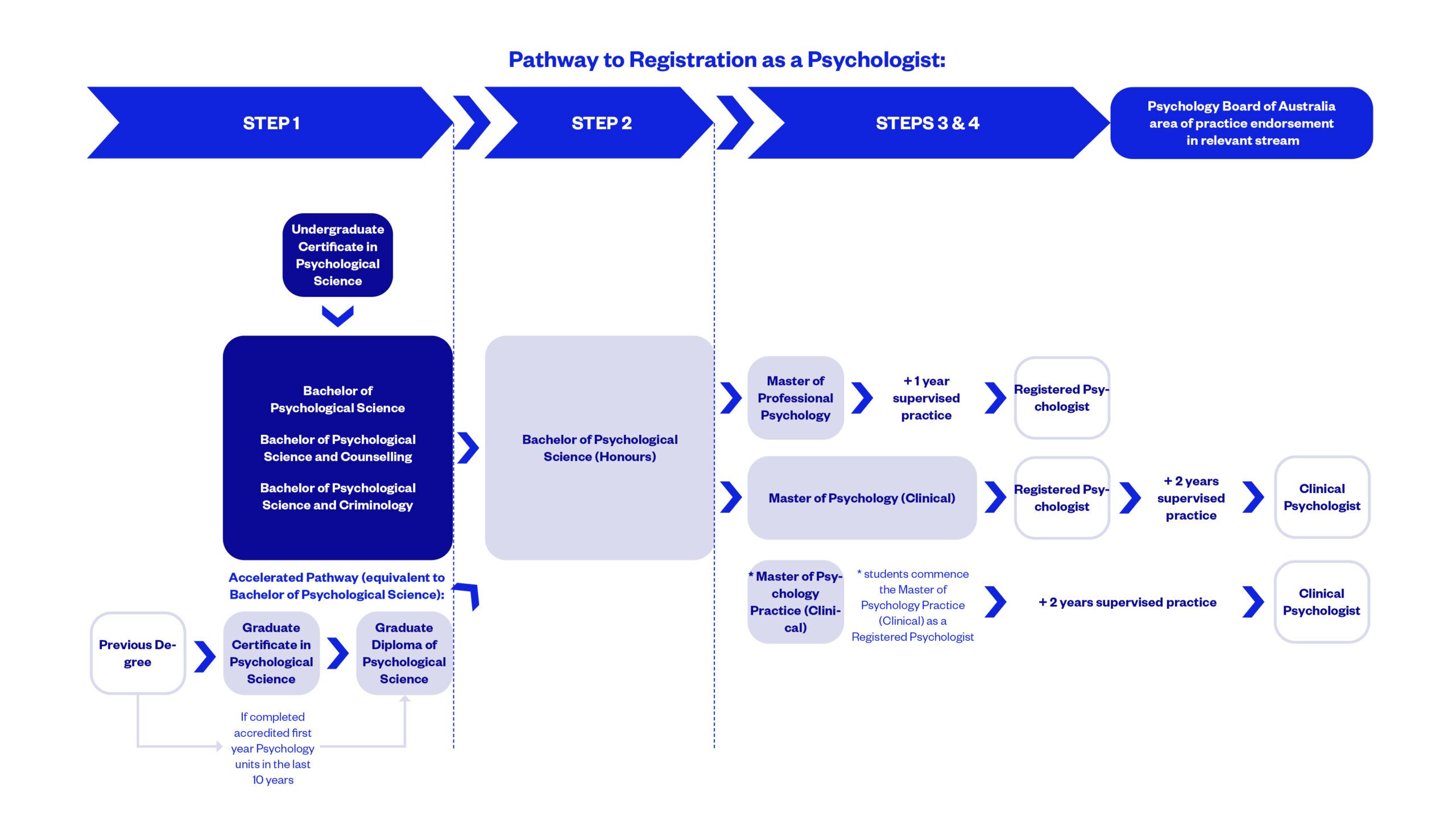
Pathway to Registration as a Psychologist
FREQUENTLY ASKED QUESTIONS
Studying psychology helps you understand why people think, feel and behave the way they do. Along the way, you’ll develop valuable skills in communication, research, critical thinking and problem solving.
Whether you’re interested in becoming a registered psychologist or pursuing a career in health, education, community services, business or research, psychology provides a strong foundation for a wide range of meaningful career pathways.
While both psychology and counselling focus on supporting people’s wellbeing, their training, scope of practice and career outcomes are different.
Psychology is a scientific discipline that explores human behaviour, cognition and mental processes. Registered psychologists are trained to conduct psychological assessments and implement psychological interventions with a diverse range of people, using evidence-based approaches. This may include working with people with mental health challenges.
Counselling focuses on helping people navigate personal challenges, relationships, life transitions and emotional wellbeing through therapeutic conversations and practical strategies. Counsellors generally don’t diagnose mental health conditions unless they hold additional qualifications within another registered profession.
To explore the similarities and differences in more detail, read our guide to the difference between psychology, counselling and social work.
Psychologists and psychiatrists both work with people experiencing mental health challenges, but their qualifications and roles are different.
Psychologists complete accredited education and supervised training to become registered with the Psychology Board of Australia. They assess, diagnose and treat mental health conditions using psychological therapies and evidence-based interventions.
Psychiatrists are medical doctors who complete specialist medical training in psychiatry. The key difference is that psychiatrists are medical doctors who can prescribe psychiatric medication.
Psychologists and psychiatrists often work together as part of multidisciplinary healthcare teams.
Yes. Becoming a registered psychologist in Australia typically requires six years of accredited education and training.
After completing an accredited three-year bachelors degree and a fourth year of psychology study (such as an honours program), you’ll undertake one of the approved postgraduate pathways. This may include completing an accredited masters degree in psychology, or the 5+1 pathway, which combines postgraduate study with supervised practice.
For more detailed information, visit our blog post about how to become a psychologist in Australia.
Studying psychology can open doors to careers across healthcare, community services, education, government, research and the private sector.
Career opportunities may include:
- Behaviour Support Worker
- Child Protection Officer
- Community Mental Health Worker
- Disability Support Coordinator
- Juvenile Justice Officer
- Mental Health Support Worker
- Registered or Clinical Psychologist*
- Social Policy Researcher
Visit our blog post to learn more about where a psychology degree could take you.
*Becoming a registered or clinical psychologist requires additional accredited study, supervised training and registration.
ACAP offers psychology courses at an undergraduate and postgraduate level, including:
- Undergraduate Certificate in Psychological Science – Explore foundational concepts in psychology.
- Bachelor of Psychological Science – Build knowledge in human behaviour, research and psychological processes.
- Bachelor of Psychological Science and Counselling – Combine psychology with practical counselling skills.
- Bachelor of Psychological Science and Criminology – Explore psychology through crime, justice and behaviour.
- Bachelor of Psychological Science (Honours) – Complete an accredited fourth year of psychology study as part of the pathway towards registration.
- Graduate Certificate of Psychological Science – As a graduate from another discipline, build foundational psychology knowledge at postgraduate level.
- Graduate Diploma of Psychological Science – Study psychology as a graduate from another discipline if you have already studied accredited first year psychology units.
- Master of Professional Psychology – Prepares students for the internship year they will need to complete before general registration.
- Master of Psychology (Clinical) – Develop advanced clinical psychology knowledge and skills.
- Master of Psychology Practice (Clinical) – Extend your clinical practice as a registered psychologist.
A simple way to think of the difference is this: All clinical psychologists are registered psychologists, but not all registered psychologists are clinical psychologists.
A registered psychologist has completed the required undergraduate education and postgraduate training for general registration with the Psychology Board of Australia.
A clinical psychologist has completed additional specialised postgraduate training in clinical psychology. Clinical psychologists typically work with people experiencing more complex mental health conditions across hospitals, private practice and specialised health services.
Becoming a registered psychologist in Australia generally takes a minimum of six years.
This includes:
- An accredited three-year bachelor’s degree in psychology
- An accredited fourth year of psychology study (such as a Bachelor of Psychological Science (Honours))
- At least two additional years of postgraduate education and training through an approved registration pathway.
Psychology students develop scientific knowledge alongside practical skills that are valued across healthcare, education, community services, research and business.
Throughout your studies at ACAP, you’ll build skills in:
- Understanding human behaviour, cognition, motivation and emotion
- Critical thinking and evidence-based problem solving
- Research methods, data analysis and scientific reasoning
- Psychological assessment and ethical decision-making
- Cultural awareness and culturally responsive practice
- Lifespan development and mental health across diverse populations
- Working with individuals, groups and communities
- Professional resilience, self-reflection and lifelong learning.
You’ll also study topics including cognition, lifespan development, abnormal psychology and social psychology, with electives available in counselling, criminology and social welfare.
No. In Australia, completing a bachelors degree alone does not qualify you to become a registered psychologist.
An accredited bachelors degree is the first step towards registration. To become a psychologist, you’ll also need to complete an accredited fourth year of psychology study, followed by an approved postgraduate education and training pathway before applying for registration with the Psychology Board of Australia.



FLEXIBLE STUDY MODES
At ACAP, we provide you with a range of flexible study options including on-campus and online psychology courses. You’ll also have the option to study full time or part time, depending on your chosen course. Whether you are combining your studies with full-time work, trying to balance your family life or hoping to further your education, we can help you reach your career goals.
-
On Campus
Attend classes for a rewarding, interactive hands-on experience at one of our 6 campuses.
-
Online
Study anywhere, anytime with our online classes including discussion forums.
-
Blended learning
A combination of live classes and online learning for freedom and practical experience.



You can be yourself
At ACAP, we promote a college culture where every voice is heard and respected, where you have freedom from discrimination and harassment, and feel supported, valued and included.
We particularly welcome students:
- of Aboriginal and Torres Strait Islander descent
- with a disability, or ongoing medical or mental health condition
- from culturally and linguistically diverse backgrounds
- of diverse genders and sexualities
- from low socio-economic backgrounds

We'll help you succeed
Our deep understanding of human behaviour is reflected in the way you study with us. Smaller, interactive classes help you excel, while our supportive study environment ensures you feel comfortable contributing your thoughts and ideas. ACAP is where your passion for learning is mirrored by our passion for experiential teaching, and where we give you the encouragement and one-on-one support to help you thrive.
We’re outcomes-focused, meaning it’s not just about what you learn while you’re with us, but what you’re capable of when you graduate. Our practical approach provides hours of real-world interaction, insight, and professional connections. You'll graduate with practical skills, enhanced confidence, and contemporary expertise that is industry-recognised and highly sought after.

We'll support you with funding options
Your fees may vary depending on your enrolment. Whether you're a self-funded domestic student, using a FEE-HELP loan or an international student, we have options to meet your needs.
- Pay Upfront: Pay your tuition fees up front by direct debit or credit card every trimester.
- FEE-HELP: A Commonwealth Government loan to help pay for all or part of your higher education course fees.